 Yusuf Yesil, MD, MIS
Beyond static image scans
Diagnosing unexplained swollen lymph nodes usually requires invasive tissue biopsies because early clinical symptoms are vague and nonspecific. Traditional diagnostic AI tools rely almost exclusively on single static ultrasound images, which limits their generalizability across different hospital scanners. Integrating several imaging modes into a single analytical architecture fundamentally shifts how clinicians evaluate hard-to-read nodal lesions.
That shift addresses a long-standing bottleneck in noninvasive diagnostics.
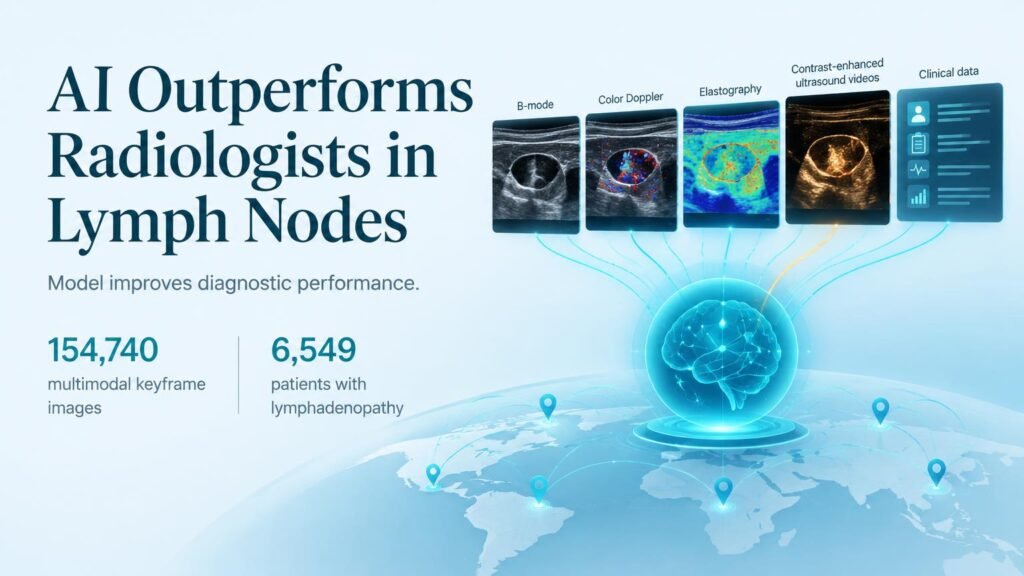
Instead of evaluating isolated static frames, researchers built a foundation model that fuses structural, vascular, and tissue-stiffness data with clinical history. The software processes standard B-mode ultrasound, color Doppler flow imaging, ultrasound elastography, and dynamic contrast-enhanced ultrasound videos. By analyzing dynamic blood flow and tissue elasticity together, the model executes three hierarchical tasks: distinguishing benign from malignant nodes, stratifying etiology, and pinpointing the primary site of metastatic origin.
Trained across diverse hardware
Medical AI frequently fails when moved from the development site to external clinics running different hardware. To evaluate true cross-device stability, researchers compiled a large multicenter cohort representing real-world diagnostic variation.
The validation effort drew on 154,740 multimodal keyframe images gathered from 6,549 pathologically confirmed patients. The data spanned seven Chinese medical centers and ultrasound systems from 11 scanner manufacturers. Across internal, external, device-heterogeneity, and multi-reader cohorts, the model surpassed senior radiologists across all hierarchical diagnostic tasks while consistently boosting reader accuracy across experience levels.
Key findings from the multicenter validation include:
- The architecture outperformed senior radiologists in differentiating benign from malignant lymphadenopathy without tissue extraction.
- Clinicians using the software improved their diagnostic performance regardless of their years of clinical experience.
- Diagnostic accuracy held firm across hardware from 11 scanner manufacturers, overcoming typical performance drops caused by device variations.
Validation limits practical deployment
These findings prove high diagnostic accuracy, but strong retrospective reader studies are not identical to improved patient outcomes. Because all 6,549 patients in the study had pathologically confirmed lymphadenopathy, the model was evaluated on a pre-selected patient population rather than an unfiltered prospective triage stream.
Multicenter testing across regional hospitals confirms strong algorithmic generalization, yet observational data cannot prove that AI assistance safely reduces unnecessary surgical biopsies in routine practice. Health systems should view this model as an effective assistant for complex triage while prospective trials evaluate its direct impact on patient management.
Read the full study in Nature Communications.