 Yusuf Yesil, MD, MIS
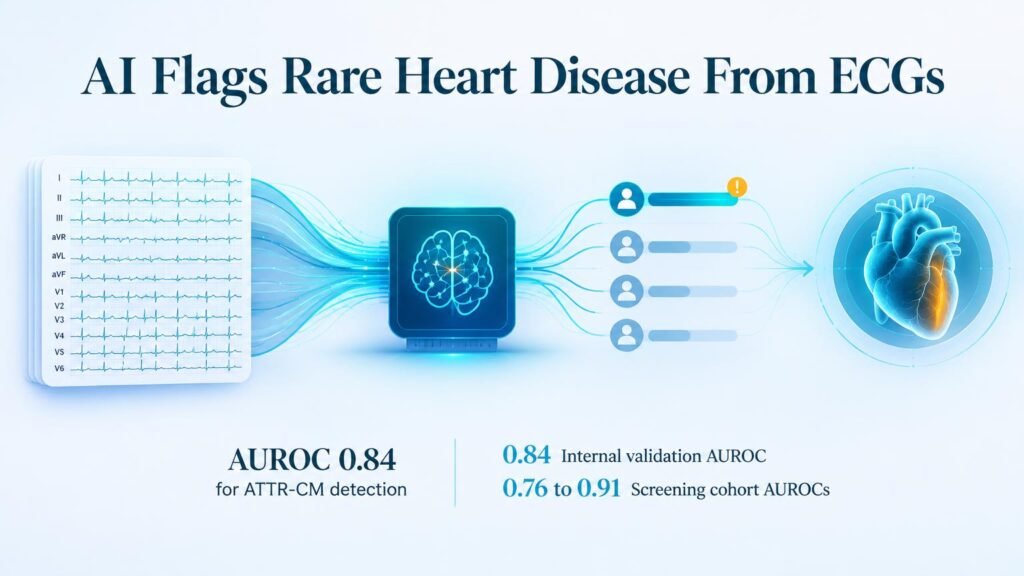
Transthyretin amyloid cardiomyopathy (ATTR-CM) is treatable, but clinicians routinely miss it until advanced damage occurs. Advanced cardiac imaging is too limited and costly to screen every heart failure patient. A study published in JAMA evaluates whether deep learning can catch this underdiagnosed disease from low-cost, routine electrocardiograms.
Researchers built the AI using 28,174 ECGs from 11,291 patients, including 293 with ATTR-CM, treated at Yale New Haven Health between August 2015 and June 2023. In an internal temporal validation cohort of 44,123 patients (mean age 68.5 years; 49.7% female), the algorithm achieved an area under the receiver operating characteristic curve (AUROC) of 0.84, with 0.72 sensitivity and 0.86 specificity.
That accuracy held firm during rigorous clinical stress testing. When tasked with distinguishing ATTR-CM from lookalike conditions like severe aortic stenosis or left ventricular hypertrophy, the model recorded an AUROC of 0.81. Among patients referred for confirmatory cardiac amyloid radionuclide imaging, it maintained an AUROC of 0.78.
Key Validation Results
- Achieved AUROCs between 0.78 and 0.89 across 5 multinational external validation cohorts.
- Reached an AUROC of 0.76 in the SCAN-MP screening cohort (n=645) and 0.79 (n=251) and 0.91 (n=121) across two CACTUS screening cohorts.
- Sequential AI-ECG followed by AI-enabled echocardiography spiked the positive predictive value from 0.24 to 0.66 while shifting sensitivity from 0.84 to 0.68.
This approach aligns with emerging research into AI applied to electrocardiographic images for scalable screening of cardiac amyloidosis. Paired with advances in using AI-enabled electrocardiography and echocardiography to track preclinical progression, these findings show how routine software checks can triage high-risk patients long before expensive nuclear scans are ordered.
The diagnostic power here is about triage, not direct medical replacement. Retrospective accuracy on static scans does not prove that software can swap out human clinicians or replace nuclear imaging. Instead, it offers health systems an automated funnel to prioritize high-yield patients for downstream diagnostic workups.
Implementation Limits
Because these findings stem from retrospective data and observational cohorts, calibration must be verified locally before clinical rollout. Systems must evaluate prospective deployment to ensure the tool reduces diagnostic delays without triggering workflow bottlenecks or unnecessary downstream testing.
Read the full paper in JAMA.