 Yusuf Yesil, MD, MIS
Gastroenteropancreatic neuroendocrine tumors present an unpredictable clinical path. Traditional markers like TNM stage and Ki-67 index leave oncologists with broad risk categories that often miss individual patient outcomes. Relying solely on these classic metrics leads to over-treating low-risk cases or missing aggressive progression.
A new cross-border study demonstrates that machine learning models can significantly outperform traditional risk scoring. However, a noticeable performance drop between domestic training sets and massive international validation data shows these tools are not ready for plug-and-play clinical use.
Algorithms outperform standard staging
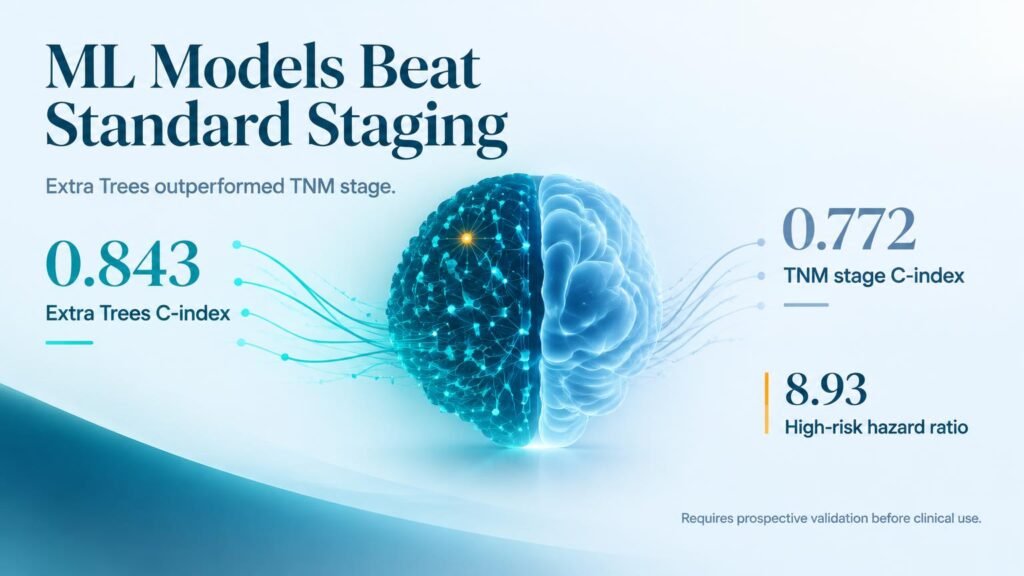
Researchers trained six survival models on a retrospective cohort of 337 Chinese patients, splitting them into 236 training cases and 101 test cases. An ensemble technique called Extra Trees achieved the highest internal predictive power. SHAP analysis revealed that T stage, tumor grade, distant metastasis status, TNM stage, and Ki-67 were the primary drivers of model predictions.
When evaluated on the independent test set, the machine learning approach cleanly separated low- and high-risk patients. The strongest results included:
- An Extra Trees discrimination index of 0.843, surpassing TNM stage (0.772), Ki-67 index (0.705), and tumor grade (0.699).
- Time-dependent AUC metrics of 0.871 at 1 year, 0.847 at 3 years, and 0.935 at 5 years.
- A high-risk stratification hazard ratio of 8.93, identifying patients with drastically lower survival probabilities.
- An external validation cohort of 51,225 US SEER patients maintaining a 0.719 C-index and stable calibration slopes between 0.901 and 1.058.
Cross-border drop signals real-world limits
The gap between the 0.843 internal C-index and the 0.719 US validation score illustrates a persistent AI challenge. Models trained on single-center cohorts struggle to maintain peak accuracy across diverse global populations with differing treatment baselines. DeepSurv actually yielded the highest external accuracy, proving that different architectures excel depending on dataset scale.
This work builds on earlier machine learning survival models for neuroendocrine neoplasms and traditional nomograms for gastrointestinal neoplasms. Yet diagnostic discrimination is not the same as improved patient outcomes. High C-indices in retrospective datasets do not prove that algorithmic recommendations alter clinical decision-making or prolong life.
Because the initial cohort remains small and retrospective, the resulting SHAP nomogram remains strictly exploratory. Clinicians should view these scores as supplementary decision support rather than a replacement for multi-disciplinary tumor boards. Prospective trials must prove these models safely refine therapy choices before health systems embed them into routine workflow.
Read the full study in Frontiers in Oncology.