 Yusuf Yesil, MD, MIS
Invasive pulmonary aspergillosis carries a staggering mortality rate in intensive care units. Clinicians often lack clear prognostic tools to identify which patients need immediate aggressive intervention upon diagnosis. A new multicenter study shows that complex artificial intelligence models are not always required to solve this problem.
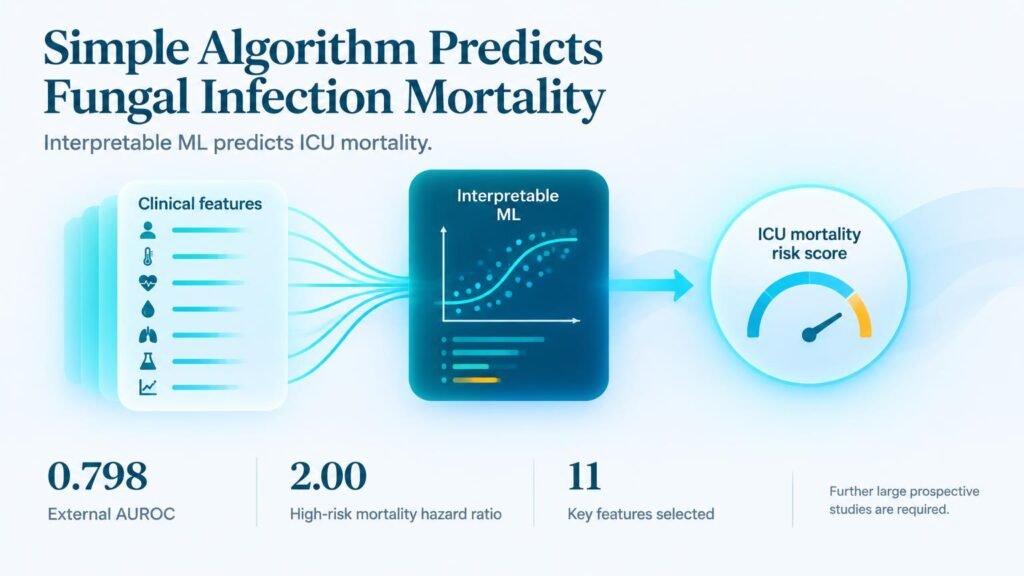
Researchers evaluated 11 individual machine learning algorithms and nine ensemble architectures against simple logistic regression. Surprisingly, basic logistic regression delivered the best overall predictive performance using 11 routine clinical features collected within 24 hours of diagnosis. That shift toward simpler models mirrors findings in interpretable machine learning for predicting in-hospital mortality in COPD ICU patients, where straightforward algorithms often outperform complex black-box approaches in critical care settings.
Simpler tools lead the way
The development cohort included 267 patients treated between 2015 and 2025, where overall ICU mortality reached 59.1%. Researchers validated the tool prospectively across 129 patients from 2022 to 2025, who had an overall mortality of 53.5%. All diagnoses followed the BM-AsperICU algorithm.
The logistic regression model achieved an internal AUROC of 0.740 and an external prospective AUROC of 0.798. It relied on 11 baseline variables including age, interstitial lung disease, prior 7-day cumulative glucocorticoid dose, neutrophil count, platelet count, blood urea nitrogen, total bilirubin, D-dimer, PaO2/FiO2 ratio, lactate, and the serum galactomannan-to-lymphocyte ratio. SHAP values confirmed feature interpretability for bedside clinicians.
That prospective boost in accuracy shows the model holds up well outside its initial training data.
Key prognostic results
- An optimal decision cutoff score of 0.54 accurately stratified patient mortality risk.
- High-risk patients faced twice the risk of ICU death with an adjusted hazard ratio of 2.00 (95% CI 1.07–3.70, P = 0.030).
- Risk prediction remained independent of patient age and baseline SOFA scores.
This independent predictive value matters because standard acuity scores like SOFA often miss fungal-specific risks. Similar challenges appear in machine learning models for severe community-acquired pneumonia, where pathogen-specific biomarkers refine general mortality estimates.
Real-world gaps remain
While the proof-of-concept web calculator offers rapid risk scoring, strong retrospective validation is not proof that software saves lives. The training cohort relied on retrospective data across a decade, which introduces potential historical treatment biases. Furthermore, the external prospective validation group remained modest at 129 patients.
Before hospitals adopt this web tool into routine clinical workflows, prospective interventional trials must demonstrate that acting on these risk scores actually reduces ICU mortality. Until then, the model serves as an interpretable risk stratification tool rather than a replacement for bedside clinical judgment.
Read the original research in Respiratory Research.