 Yusuf Yesil, MD, MIS
Digital health platforms frequently bombard users with dozens of generic behavioral prompts. This scattershot approach bloats intervention design without showing which specific features actually change patient habits.
That lack of focus limits digital therapeutics. By analyzing real-world counseling transcripts with feature-selection algorithms, researchers isolated the core drivers of sustained abstinence. The findings challenge digital health developers to strip away non-essential features and double down on targeted behavioral strategies.
Mapping the Effective Dialogue
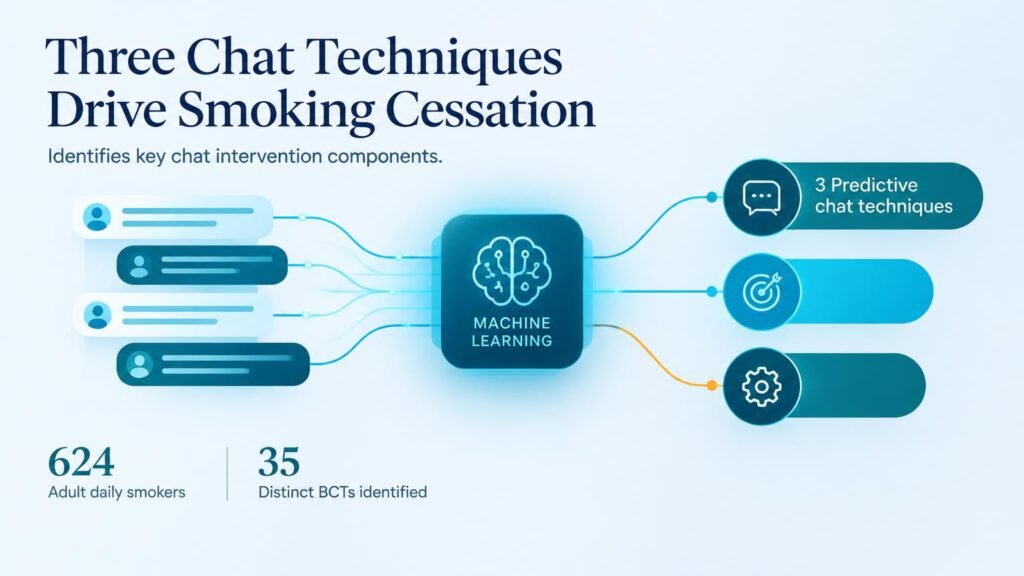
Researchers conducted a secondary analysis of a pragmatic cluster-randomized trial in Hong Kong. Out of 624 daily smokers recruited across 34 community sites, 230 participants engaged in instant messaging support over 3 months. The analytic cohort was 73.9% male with a mean age of 43.0 years.
Counselors delivered a total of 35 distinct behavior change techniques during chat sessions. To determine which techniques truly drove results, four machine learning algorithms evaluated transcript features. The team used LASSO regression, Extreme Gradient Boosting, the Boruta algorithm, and recursive feature elimination, validating results across 500 bootstrap resamples.
Only three techniques met the supermajority threshold across models, demonstrating stability ratings between 61% and 100%. This rigorous filtering aligns with broader research into live chat smoking cessation coaching skills, which emphasizes structured behavioral components over passive support.
Key Predictors of Abstinence
The statistical impact of these three techniques on biochemically validated abstinence at 6 months was substantial:
- Contingent rewards (BM4): Risk ratio of 7.9 (95% CI 4.2–14.6) for 6-month abstinence.
- Information on withdrawal symptoms (RC6): Risk ratio of 3.3 (95% CI 1.6–6.5) at 6 months.
- Information on health consequences (BM1): Risk ratio of 2.7 (95% CI 1.4–5.5) at 6 months.
Rewarding success yielded the largest effect size by a wide margin. Reinforcing personal agency and managing expectations around withdrawal proved far more effective than high-frequency generic prompts, reflecting core principles identified in behavior change program reviews.
Analytical Limits and Takeaways
Retrospective feature extraction cannot prove direct causal mechanics. The analysis relied on a sub-sample of 230 engaged participants, creating potential self-selection bias toward motivated individuals. Furthermore, these sessions involved human counselors rather than automated conversational AI.
However, the operational lesson for software teams is direct. Future automated cessation tools should prioritize contingent reward triggers and clear withdrawal education rather than complex, multi-component dialogue flows. Developers can streamline chat workflows around these high-yield interactions to maximize clinical impact.
Read the full study in the Journal of Medical Internet Research.