 Yusuf Yesil, MD, MIS
Missed cases of Kawasaki disease leave children at risk for permanent coronary artery damage. Early symptoms often mirror common childhood fevers. Clinicians frequently struggle to confirm the diagnosis during the critical early window when treatment is most effective.
A new diagnostic model changes this dynamic by combining blood-based microRNA profiles with standard patient data. Rather than relying solely on non-specific inflammatory markers, researchers built a targeted machine learning pipeline. The approach clarifies diagnosis exactly when clinical presentations are most ambiguous.
Validating the Biomarker Engine
The trial examined 120 children split evenly between 60 confirmed cases and 60 febrile controls. Researchers evaluated three candidate reference genes across 40 patients using geNorm, NormFinder, and BestKeeper algorithms. They identified miR-126-3p as the most stable baseline reference for quantitative real-time PCR normalization.
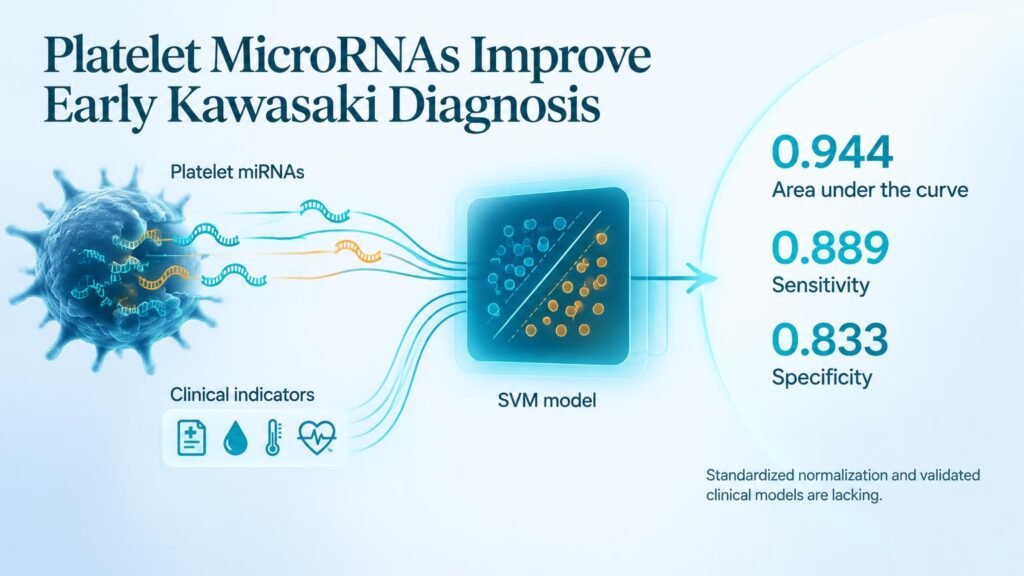
After isolating 12 platelet microRNAs, seven showed significant upregulation in patients with the disease. Investigators fed these genetic signals alongside routine laboratory values into five distinct machine learning models. Feature selection via LASSO refined the inputs to maximize diagnostic accuracy.
Prior studies established that MiR-222-3p in platelets serves as a key marker for early detection. Subsequent work confirmed the broader diagnostic potential of platelet microRNA profiles in Kawasaki disease. This study builds on those insights by standardizing normalization to deliver a deployment-ready predictive tool.
High Accuracy Under Pressure
The top-performing support vector machine model demonstrated strong diagnostic precision across tenfold cross-validation:
- Achieved an area under the curve of 0.944 (95% CI: 0.748–0.969).
- Reached a sensitivity of 0.889 for detecting active cases.
- Maintained a specificity of 0.833 against febrile controls.
Critically, performance held up in atypical presentations and early fevers lasting 5 days or fewer. That early detection window is where misdiagnosis rates normally spike.
Accuracy was high, but the trial relies on internal validation in a small cohort. Retrospective diagnostic precision does not automatically guarantee better patient outcomes in busy pediatric wards. External multicenter validation across diverse patient populations must occur before replacing current diagnostic protocols.
What Clinicians Should Watch
This model proves that combining molecular signatures with clinical data solves real diagnostic blind spots. It offers a practical path toward objective testing for incomplete cases.
Translating this tool to the bedside requires rapid PCR turnaround times and seamlessly integrated software. Until prospective clinical trials confirm that this algorithm speeds up treatment decisions and prevents heart complications, it remains a promising validation study rather than a immediate standard of care.
Read the complete study in BMC Pediatrics.