
A simple point-based scale built from eight clinical features can spot secondary infections in severe fever with thrombocytopenia syndrome (SFTS) before culture results come back.
SFTS carries a high risk of death, largely because secondary bacterial or fungal superinfections hit patients when their immune systems are compromised. Waiting for lab cultures delays targeted therapies and leads to indiscriminate antibiotic use. This study shows that complex machine learning models can be distilled into a practical bedside tool that flags vulnerable patients early.
That transition from black-box algorithms to a bedside checklist is the real story here.
Rather than pushing an unexplainable artificial intelligence model into the ward, researchers converted their best algorithm into a simple point system. This bridges the gap between predictive performance and clinical utility in high-acuity settings.
Testing across four hospitals
The researchers assembled an ambispective cohort of 1,942 patients across four hospitals in China to build and test their tool. The development phase used a retrospective cohort of 1,182 patients from two hospitals, split into a training set (n = 823) and an internal validation set (n = 359). External validation drew from two additional hospitals with 475 patients, followed by a real-world prospective evaluation in 2025 of 285 patients.
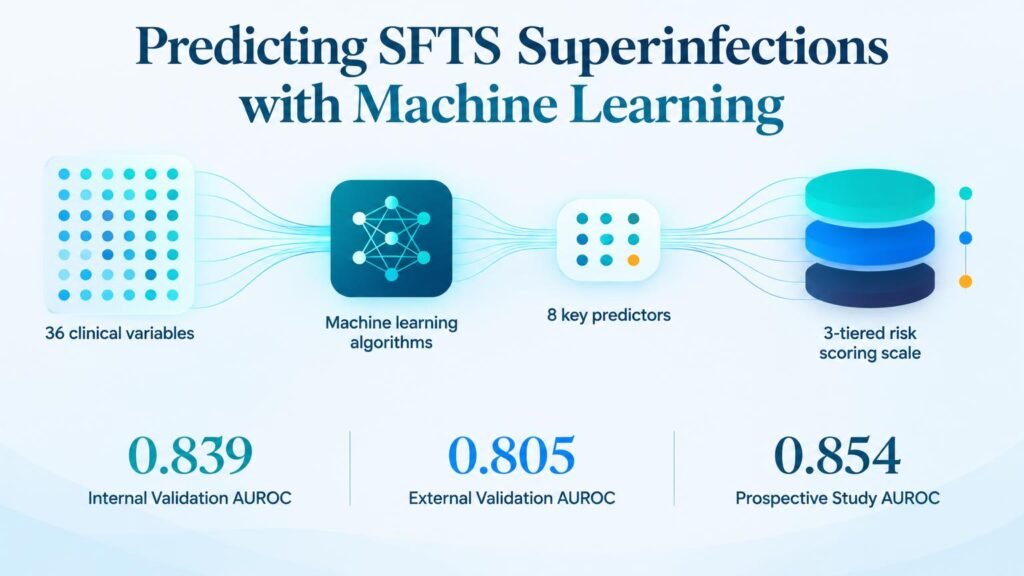
Out of 36 candidate variables, an ensemble of five machine learning algorithms isolated 8 core predictors: age, albumin (ALB), aspartate aminotransferase (AST), blood urea nitrogen (BUN), glucose (GLU), C-reactive protein (CRP), hemoglobin (HGB), and the presence of expectoration.
Model performance and simple scoring
The team evaluated Random Forest, XGBoost, LightGBM, and Logistic Regression (LR) algorithms built on these eight features. Logistic Regression emerged as the optimal performer and formed the foundation of the simplified scoring scale.
- Internal Validation: The LR model achieved an AUROC of 0.839 (95% CI: 0.797–0.880).
- External Validation: Across independent centers, performance held steady with an AUROC of 0.805 (95% CI: 0.764–0.847).
- Prospective Real-World Cohort: In live clinical settings, the tool achieved its highest accuracy with an AUROC of 0.854.
The final nomogram was condensed into a 3-tiered risk scale to help clinicians triage patients quickly without needing specialized software.
Clinical impact and practical limits
This work complements broader efforts to stratify severe viral disease, such as using machine learning for mortality prediction in SFTS and creating a mortality risk stratification simplified scoring scale. While mortality tools highlight overall prognosis, targeting superinfections directly gives clinicians a specific therapeutic lever: timely, responsible antimicrobial stewardship.
However, predictive accuracy is not identical to improved survival. The study demonstrates strong discrimination across retrospective and prospective validation cohorts, but it does not prove that acting on these scores reduces mortality or shortens hospital stays. Regional variation in baseline pathogen prevalence may also alter how well these specific cutoff points translate to hospitals outside China.
Clinicians should view this 3-tiered scale as a risk-stratification trigger rather than an automated decision-maker. The practical gain lies in identifying high-risk individuals early to target diagnostic workups, while holding back broad-spectrum antimicrobials on lower-risk patients.
Read the full study in PLoS Neglected Tropical Diseases.