

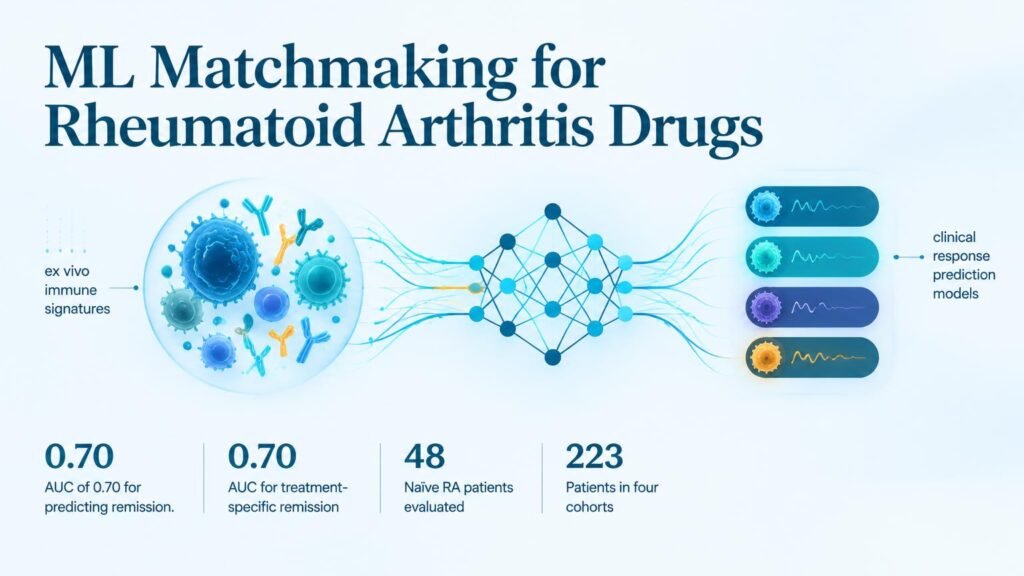
A simple blood assay paired with machine learning can help predict whether rheumatoid arthritis patients respond better to JAK or TNF inhibitors before taking their first pill.
Rheumatoid arthritis treatment often relies on trial and error. Patients spend months on costly targeted therapies that might fail while irreversible joint damage progresses. A new study shows that matching patients to their optimal drug class at the start of treatment is technically feasible, though predictive tools still face substantial performance limits.
That distinction between biological plausibility and clinical readiness is critical. While machine learning can pick up distinct immune signals, a moderate predictive score means these tools cannot yet replace physician judgment on their own.
Ex Vivo Modulated Immune Signatures
Researchers began by analyzing peripheral blood mononuclear cells and neutrophils from 48 b/tsDMARDs-naïve patients. Treating these cells ex vivo with either Baricitinib (a JAK inhibitor) or Etanercept (a TNF inhibitor) revealed distinct 92-protein inflammatory profiles with surprisingly little overlap between the two drug mechanisms.
To validate whether these signatures mattered in living patients, the team tested pretreatment baseline serum across four independent cohorts totaling 223 patients. High baseline expression of a drug-specific protein signature was associated with remission under that drug—and failure to achieve remission if given the alternative therapy instead.
This biological cross-talk mirrors findings from integrative proteomic and machine learning strategies that attempt to map response markers before starting targeted therapy. Similar efforts focused on Fas+ T cell subsets have highlighted how cellular baseline profiles dictate targeted drug efficacy in autoimmune disease.
Model Performance and Clinical Limitations
The team built predictive models using repeated nested cross-validation to forecast treatment-specific remission at six months for drug-naïve patients.
- Logistic regression performed best among tested models, achieving a mean AUC of 0.70 (SD, 0.03; empirical 2.5th–97.5th percentile, 0.65–0.75).
- In patients who achieved remission, 6-month post-treatment sera significantly reduced synovial lining thickness in a 3D synovial micromass model compared to baseline.
- Unsupervised clustering linked specific baseline molecular signatures directly to longitudinal ΔDAS28-CRP changes at 3, 6, and 12 months.
An AUC of 0.70 represents moderate discrimination, not absolute accuracy. In practice, a third of predictions will still be wrong, meaning clinicians cannot rely on this algorithm as a standalone diagnostic decision-maker.
What Needs to Change Next
The study moves the field past generic inflammatory metrics toward drug-specific biomarker matching. Demonstrating structural tissue improvement via 3D synovial micromasses provides real biological validation that drug-specific remission translates to halted joint destruction.
Before these algorithms can alter clinical workflows or insurance coverage rules, prospective randomized trials must prove that biomarker-guided selection outperforms standard care in clinical outcomes and cost-effectiveness. Until then, ex vivo immune profiling remains a promising research framework rather than a frontline diagnostic tool.
Read the full peer-reviewed study in Biomarker Research.