
Giving new and expectant mothers access to a generative AI chatbot does not reduce anxiety or depression symptoms over a full year.
Deploying conversational AI to bridge gaps in maternal care sounds like a quick clinical win. A nationwide randomized trial shows software access alone fails to improve health outcomes for minoritized patients.
That quiet failure highlights a critical gap between automated tool distribution and clinical benefit.
Testing AI Against Books
Between October 2023 and December 2024, trial investigators enrolled 400 English-speaking participants across 49 US states and the District of Columbia. Every participant was aged 14 years or older, pregnant or parenting an infant younger than 6 months, and self-identified as a member of a racial or ethnic minoritized group. Among the participants, 188 (47%) identified as Black or African American, 80 (20%) as Asian, 65 (16%) as Hispanic or Latino, 57 (14%) as multiracial, and 10 (2%) as American Indian or Alaska Native. The cohort had a mean age of 32.6 years (standard deviation 5.1), and 200 (50%) were parenting an infant at enrollment.
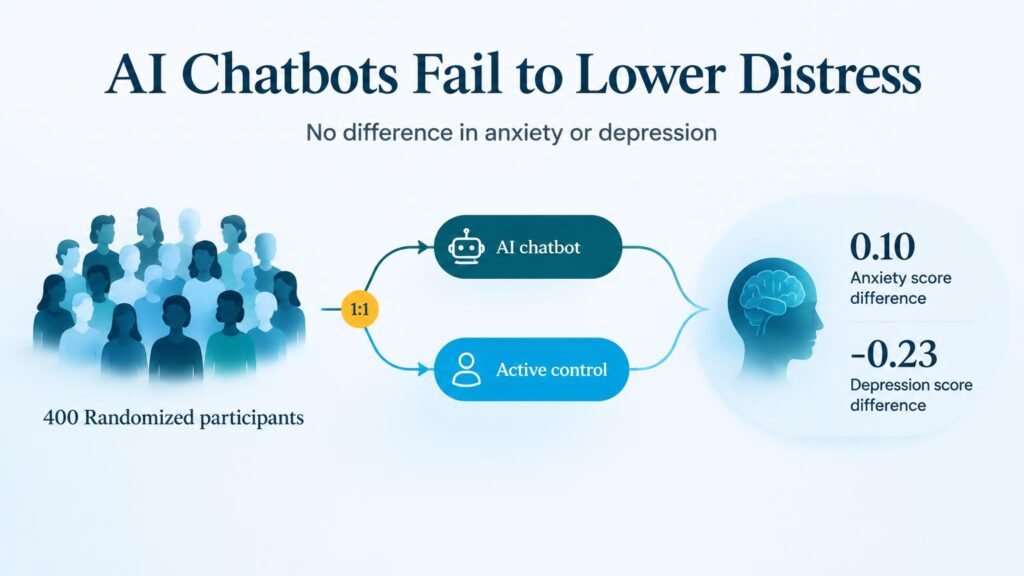
Researchers randomized participants 1:1 to receive access to a generative AI maternal health chatbot or an active control offering monthly children’s books. Follow-up concluded in December 2025.
Zero Benefit for Primary Endpoints
At 12 months, conversational access produced no measurable improvement in psychological health or clinical utilization metrics.
- Anxiety symptoms measured on the GAD-7 showed an adjusted mean difference of 0.10 (95% CI, -0.77 to 0.96).
- Depression symptoms on the PHQ-9 showed an adjusted mean difference of -0.23 (95% CI, -1.05 to 0.59).
- No significant differences appeared for emergency department visits, postpartum care checkups, effective contraception use, or sleep duration.
Engagement Brought Mixed Signals
Secondary and exploratory analyses yielded conflicting signals. Participants who were pregnant at enrollment reported more pregnancy-related complications in a secondary 12-month cross-sectional analysis, though this association vanished in longitudinal modeling.
Exploratory within-group analyses linked higher chatbot engagement to longer sleep duration, but also to higher anxiety scores.
It remains uncertain whether anxious users sought out the bot more frequently or whether conversational feedback fed user worry.
The Reality of Digital Care
While this trial tested software across a diverse national sample, key limitations affect the findings. Self-reported secondary endpoints invite recall bias, and exploratory correlation does not prove causality.
Health systems cannot treat standalone conversational tools as adequate substitutes for structured clinical intervention or human-led postpartum care.
Read the full findings in JAMA Network Open.