
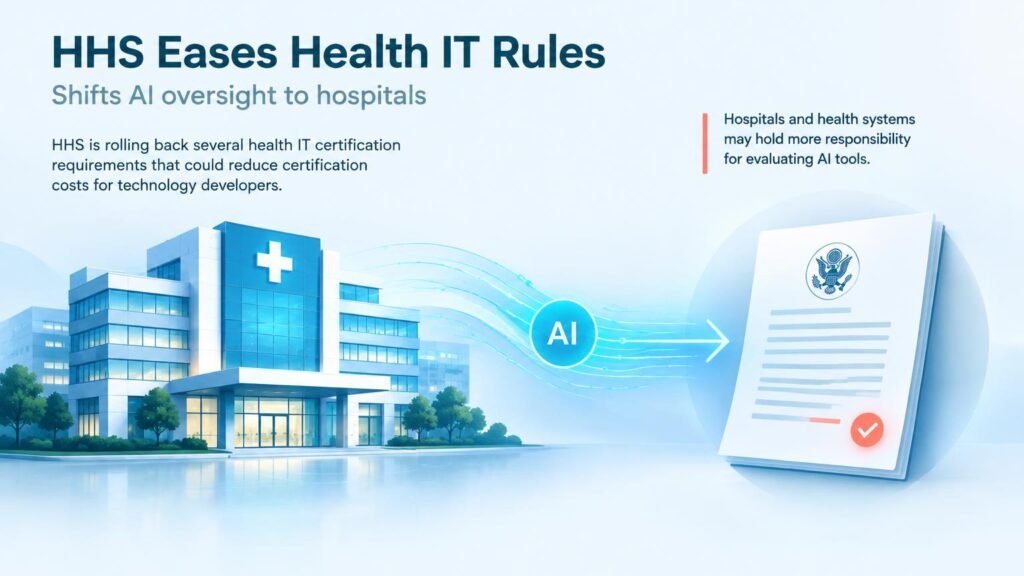
Deregulation reduces developer compliance costs but forces health systems to build their own clinical AI vetting mechanisms.
Federal regulators are cutting mandatory AI safety checks for software vendors. The Department of Health and Human Services finalized the HTI-5 rule, removing 14 health IT certification criteria. Crucially, the update eliminates required model card disclosures for predictive AI tools.
This decision aims to cut $1.55 billion in compliance costs and spur software development.
Yet, financial savings for software vendors create an immediate operational burden for hospitals. Without mandated standardized risk disclosures, health systems must independently audit AI algorithms for bias, safety, and clinical performance.
The Vetting Burden
Evaluating algorithm accuracy and safety requires specialized staff, rigorous data validation, and dedicated governance committees. While electronic health record vendors like Epic voluntarily promise to continue providing transparency documentation, smaller developers have no obligation to disclose how their predictive models make decisions.
Unvetted AI performance varies wildly across distinct patient populations. Shifting validation from federal certification standards to hospital IT teams increases the risk of deploying flawed tools in live clinical settings.
What Changes Next
Health systems have until December 2026 to prepare. Hospital leadership must establish rigorous internal oversight processes immediately, as unverified predictive algorithms threaten patient safety and expand institutional legal liability.