

Adding four blood proteins to standard demographic data improves long-term chronic kidney disease prediction models.
A standalone blood protein test cannot beat basic patient demographics at predicting chronic kidney disease on its own. But pairing proteins with demographic data creates a sharper early-warning system.
That distinction matters for clinical adoption. Software tools built to replace standard medical records often fail in clinical practice. This study demonstrates that machine learning delivers the most value by augmenting standard clinical data rather than replacing it.
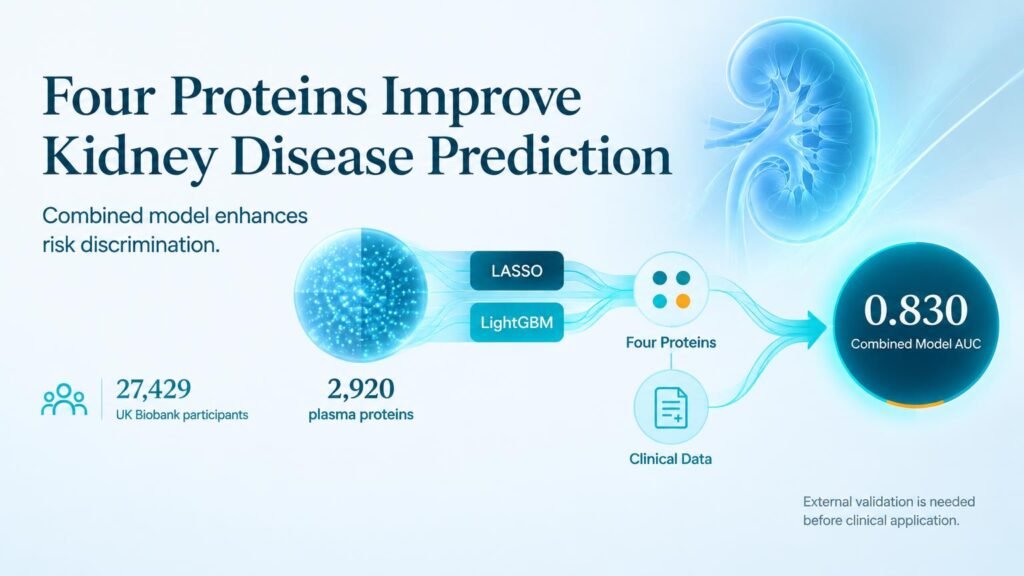
Researchers tracked 27,429 UK Biobank participants without kidney disease at baseline. They screened 2,920 plasma proteins using Cox regression, narrowed the list to 23 using LASSO regression, and selected four target proteins with a Light Gradient Boosting Machine model: EDA2R, GDF15, HAVCR1, and SCARB2.
Combining Proteins With Clinical Demographics
On its own, the four-protein AI model scored an area under the receiver operating characteristic curve (AUC) of 0.796. That performance was statistically equivalent to a simple demographic model, which reached an AUC of 0.805 (p = 0.14). Combining the four proteins with demographic factors pushed predictive performance to an AUC of 0.830 (95% CI, 0.806-0.855; p < 0.001).
Key findings from the study include:
- Initial screening identified 205 proteins associated with incident kidney disease.
- The LightGBM pipeline distilled the panel down to four key proteins.
- The combined model sustained performance across 5-year, 10-year, and >10-year risk windows.
This result reinforces earlier efforts to build a proteomics-based machine learning approach for diagnosing renal disease. It also aligns with research pairing a proteomic signature coupled with clinical risk equations to forecast disease progression.
Validation Remains the Main Barrier
The statistical gain is clear, but practical implementation faces real obstacles. Retrospective performance in a single biobank cohort does not guarantee that a software tool will lower patient harm or change physician behavior.
Assay costs for multi-protein blood panels also far exceed the cost of pulling age or medical history from an electronic health record. Because this cohort comes entirely from the UK Biobank, rigorous external validation across diverse healthcare systems is required before clinical rollout.
The practical takeaway is straightforward. Machine learning pipelines should not try to bypass routine clinical data, but rather extract additional signals hidden within complex biological profiling.