
Machine learning models applied to landmark trial data show cooling cardiac arrest patients to 33 °C offers no hidden benefit to specific high-risk subgroups over standard fever control.
Critical care specialists long suspected hypothermia failed to improve survival in major cardiac arrest trials because the effect was hidden inside specific patient subgroups. Proponents argued that patients with severe brain ischemia or specific neurological presentation at admission might still gain a survival edge from aggressive cooling.
Advanced machine learning just dismantled that hypothesis.
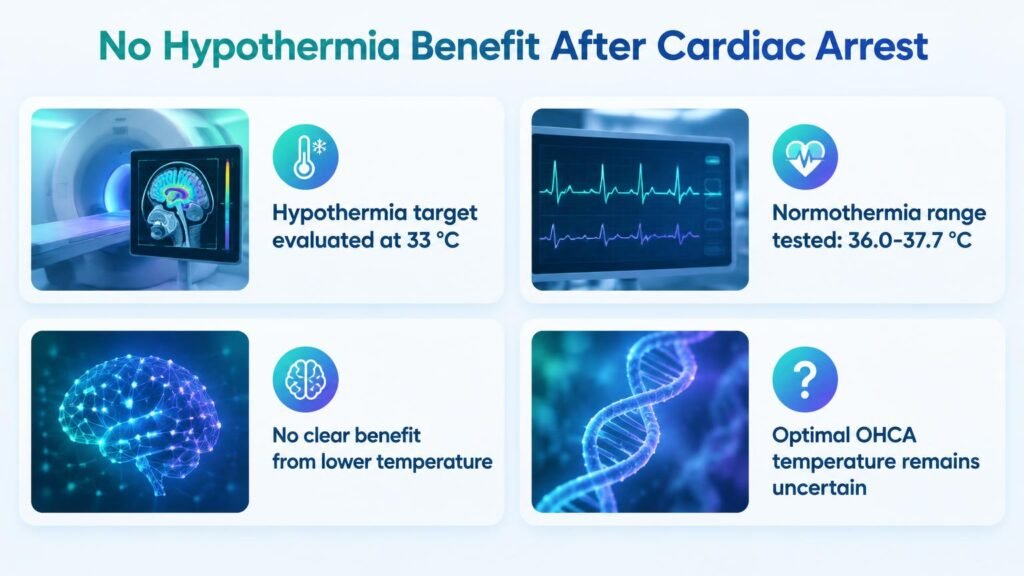
A secondary analysis published in Critical Care applied causal forests and Bayesian additive regression trees (BART) to data from 2,789 adult out-of-hospital cardiac arrest patients in the TTM and TTM2 trials. The algorithms searched for heterogeneous treatment effects based on ischemia duration, prehospital factors, and baseline neurological exams. They found zero clinical subgroups that benefited from targeted temperature management at 33 °C compared to controlled normothermia (36.0–37.7 °C).
Zero Subgroup Benefit Discovered
The total cohort had a median age of 65 years and was 79.9% male. Overall six-month all-cause mortality reached 49.4% in the 33 °C group compared to 47.9% in the controlled normothermia group. The machine learning models confirmed this parity was uniform across all clinical presentations.
The analytical findings detail a consistent lack of treatment modification across all tested metrics:
- Mortality Risk Difference: Pooled causal forest modeling yielded an estimated conditional mean mortality risk difference ranging from -1.2% to 2.1% (p = 0.99).
- Probability of Benefit: BART models calculated posterior probabilities for hypothermia benefit between just 42% and 53%, equivalent to a coin toss.
- Functional Outcomes: Secondary analysis of poor six-month functional status (modified Rankin scale score 4–6) showed identical non-significant results.
- Variable Importance: Treatment effect modifier analysis identified no baseline clinical features that meaningfully altered response to therapeutic cooling.
Rethinking Protocols and Resource Allocation
This finding complicates the rationale for maintaining complex cooling protocols for suspected high-risk sub-phenotypes. Historically, post-arrest guidelines like the Neurocritical Care Society TTM Guidelines and consensus documents such as the SCAI Consensus Statement emphasized aggressive temperature control. While targeted cooling to 33 °C incurs significant operational costs, equipment overhead, and clinician workload, these precision algorithms confirm it yields no detectable survival advantage over strict fever avoidance.
That realization carries immediate clinical consequences.
Hospitals can safely streamline post-arrest pathways around normothermia without fear that they are withholding a life-saving intervention from severe ischemic cases. Intensive care units can reallocate nursing labor and monitoring resources away from managing therapeutic hypothermia shivering and rewarming complications toward general hemodynamic stabilization.
Model Constraints and Practical Takeaways
This study has clear limitations. The machine learning models relied on routine bedside variables, ischemia times, and admission neurological scores. They could not evaluate unmeasured biological endotypes, serum biomarkers, or advanced neuroimaging patterns that were absent from the original trial registries.
Retrospective machine learning cannot invent signal where routine clinical variables carry none. The practical takeaway for critical care directors is direct: absent prospective trial evidence identifying a novel biological marker, protocolizing hypothermia at 33 °C for specific clinical presentations offers no patient benefit and should not drive ICU care planning.
Study details are published in Critical Care.