
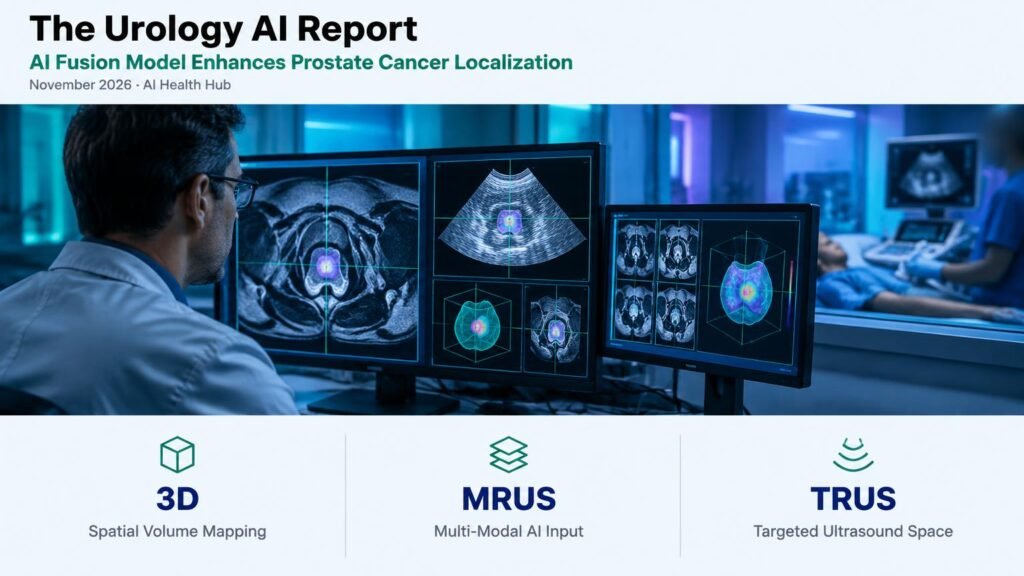
Accurate targeted biopsy of prostate cancer relies on precise spatial localization of suspicious lesions. While pre-biopsy magnetic resonance imaging (MRI) is widely utilized to identify targets, transrectal ultrasonography (TRUS) remains the primary real-time guidance modality during biopsy procedures. Translating cognitive or software-fused MRI targets into the 3D ultrasound space often introduces registration errors and reader variability. A study published in the British Journal of Urology evaluated MRUSuNet, a deep learning architecture designed to merge pre-procedural MRI and TRUS images to map the 3D spatial volume of clinically significant prostate cancer directly within TRUS space (BJU International).
Direct Multi-Modal Fusion
The MRUSuNet model integrates soft-tissue structural data from MRI alongside real-time TRUS imaging signals. By learning direct cross-modal correspondences, the system projects suspicious tumor volumes into ultrasound coordinates, outperforming standard radiologist MRI interpretation alone for lesion localization within the TRUS target zone. This dual-input approach addresses the spatial mismatch frequently encountered during targeted biopsy guidance.
Validation and Clinical Scope
Despite these technical gains in diagnostic imaging, the study’s scope remains focused on image-based spatial localization rather than prospectively verified clinical outcomes. Retrospective software validation on paired imaging datasets demonstrates improved volume accuracy, but it does not establish a reduction in missed clinically significant cancers, lower repeat biopsy rates, or improved long-term patient survival without prospective clinical trial validation.
Practical Takeaway
Urologists and diagnostic radiologists should view multi-modal AI models like MRUSuNet as emerging spatial navigation aids rather than immediate replacements for clinical judgment or standard fusion platforms. Practical deployment requires prospective validation across diverse ultrasound hardware and operator skill levels to confirm that automated TRUS-space target mapping translates directly to superior biopsy yields.