
A multi-outcome AI model improved doctor recommendation quality scores in a 200-patient prospective trial.
Managing diabetic foot ulcers forces clinicians to evaluate multiple competing risks simultaneously. Most existing risk calculators focus only on isolated events, such as in-hospital amputation rates. This clinical disconnect leaves physicians guessing how a treatment plan affects long-term recurrence or overall survival.
A multi-outcome framework directly targets that gap. By predicting four separate endpoints at once, the system shifts software from a passive calculator into an active assistant for complex wound care.
Model Derivation and Testing
Researchers built an ensemble combining single-task extreme gradient boosting and multilayer perceptron algorithms. The team gathered electronic medical records from 763 patients across two Chinese medical centers between 2018 and 2025. In this training cohort, outcomes included 638 cures, 208 recurrences, 226 amputations, and 167 deaths.
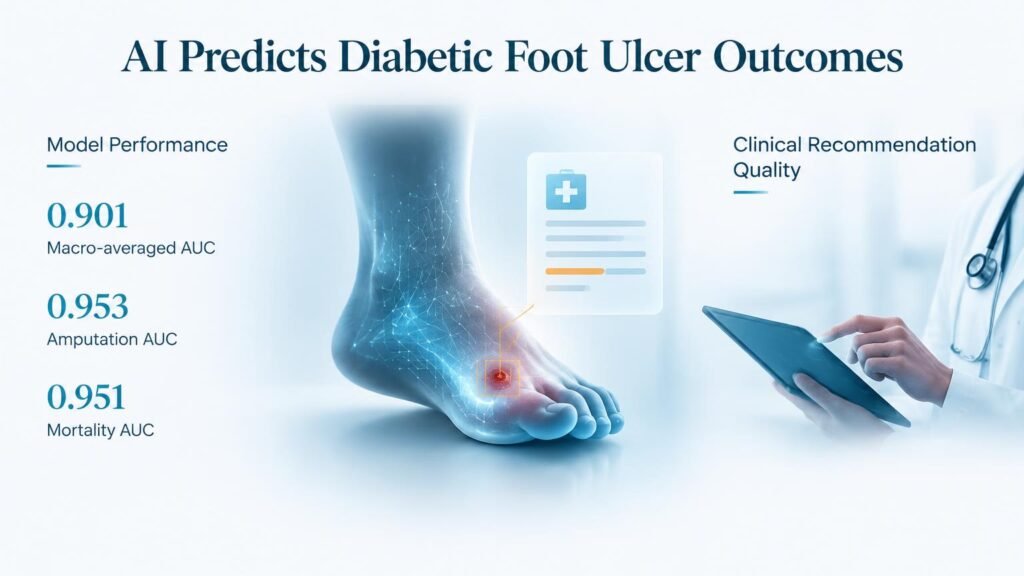
Researchers then validated the locked ensemble on an external cohort of 100 patients from a third hospital. That test dataset contained 80 cures, 34 recurrences, 24 amputations, and 25 deaths. Across all four endpoints, the model reached a macro-averaged AUC of 0.901, an overall accuracy of 0.875, and an F1 score of 0.830.
Validation and Trial Metrics
- AUC 0.953 for amputation and AUC 0.951 for all-cause mortality demonstrated the highest discrimination.
- AUC 0.880 for cure and AUC 0.820 for ulcer recurrence provided slightly lower discrimination.
- Recommendation quality scores rose from 6.47 to 7.77 (mean difference 1.30) in the prospective evaluation.
Workflow Integration and Limits
To evaluate prospective clinical utility, researchers randomized 200 patients to receive either usual care or AI-assisted decision support. Physicians using the web platform produced treatment plans with higher overall quality scores, driven primarily by improvements in recommendation completeness. Patients in the AI-assisted arm also exhibited better short-term follow-up engagement and glucose control adherence.
That behavioral shift is the central takeaway. Decision support tools often fail because clinicians ignore black-box outputs, but Shapley additive explanations helped doctors understand and act on specific risk factors.
The findings come with clear operational boundaries. Recurrence prediction remained the weakest performing task at AUC 0.820, meaning physicians must interpret lower-tier risk flags with caution. Furthermore, the prospective trial measured recommendation quality and short-term compliance rather than long-term limb preservation or hard survival endpoints.
As noted in broader surveys of machine learning in diabetic foot ulcer care, algorithms must prove they improve real-world decisions before claiming clinical benefit. This study shows that explainable multi-outcome models can meaningfully upgrade treatment planning. Read the full research in EClinicalMedicine.