

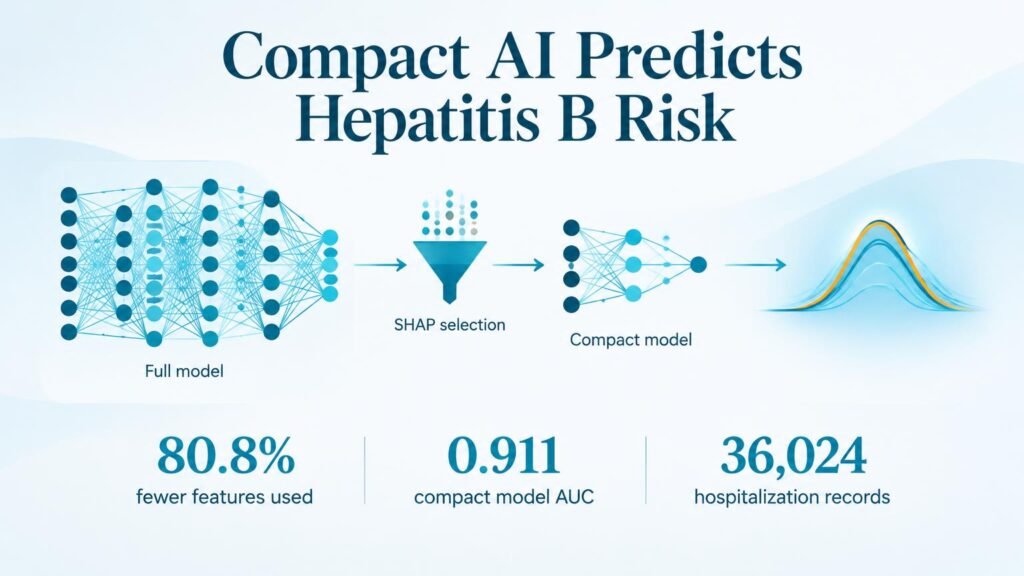
Trimming clinical data inputs by four-fifths barely degrades AI performance when assessing chronic hepatitis B severity during hospital admission.
Hospitals routinely collect hundreds of clinical variables per patient, yet bloated predictive models create operational friction without improving care decisions. Complex algorithms often stall in clinical workflows because they demand missing lab values or obscure parameters.
A new study in npj Digital Medicine shows that interpretability-driven feature selection can break this trade-off between predictive power and usability. By stripping away redundant data, researchers built lean models for chronic hepatitis B stratification that preserve diagnostic accuracy while drastically reducing the burden on clinical software.
Pruning Data Without Losing Precision
The research team evaluated 36,024 hospitalization records from 22,001 patients with chronic hepatitis B. Their goal was to classify three distinct hospital outcomes: disease non-progression, liver cirrhosis (LC), and hepatocellular carcinoma (HCC).
Using SHapley Additive exPlanations (SHAP), the framework selected the top 15 features per outcome alongside four pairwise interaction terms. This approach reduced the required data features by 80.8% compared to full-spectrum clinical models.
The original full-feature models set a high benchmark, reaching discrimination AUCs of 0.927 for non-progression, 0.897 for LC, and 0.899 for HCC. Surprisingly, discarding four-fifths of the data variables cost the system almost no predictive power.
Performance Across Validations
- Compact Models: Maintained robust discrimination with AUCs of 0.911 (non-progression), 0.882 (LC), and 0.890 (HCC) using 80.8% fewer inputs.
- Interaction Models: Yielded subtle shifts in AUCs at 0.912 (non-progression), 0.881 (LC), and 0.891 (HCC) while exposing clinical joint-effect patterns.
- Temporal Validation: Preserved predictive skill over time, recording AUCs of 0.863, 0.827, and 0.847 respectively.
- External Validation: Evaluated on independent hospital datasets, achieving AUCs of 0.829 for non-progression, 0.865 for LC, and 0.827 for HCC.
Real-World Limits and Takeaways
The notable drop in AUC scores during temporal and external validation exposes the primary bottleneck. Model performance degraded from near 0.93 down to 0.827 when applied to outside populations. This degradation proves that streamlined algorithms still struggle with site-specific dataset shifts and cannot replace clinical oversight without local recalibration.
That accuracy drop is a necessary reality check.
Nevertheless, the operational lesson is clear for health systems designing point-of-care tools. High-performing risk stratification does not require massive feature sets. By prioritizing model interpretability during design, engineering teams can deploy lightweight, transparent tools that integrate directly into routine admission workflows without sacrificing patient safety.
Read the full paper in npj Digital Medicine.