
Predictive algorithms could curb unnecessary CT scans and antibiotic changes in cancer patients by identifying who will stop running a fever.
When hospitalized cancer patients continue to run a fever after starting intravenous antibiotics, standard protocol pushes clinicians toward aggressive action. Doctors frequently order chest CT scans and escalate antimicrobial coverage to prevent rapid clinical decline. Yet many of these fever spikes resolve on their own if given sufficient time.
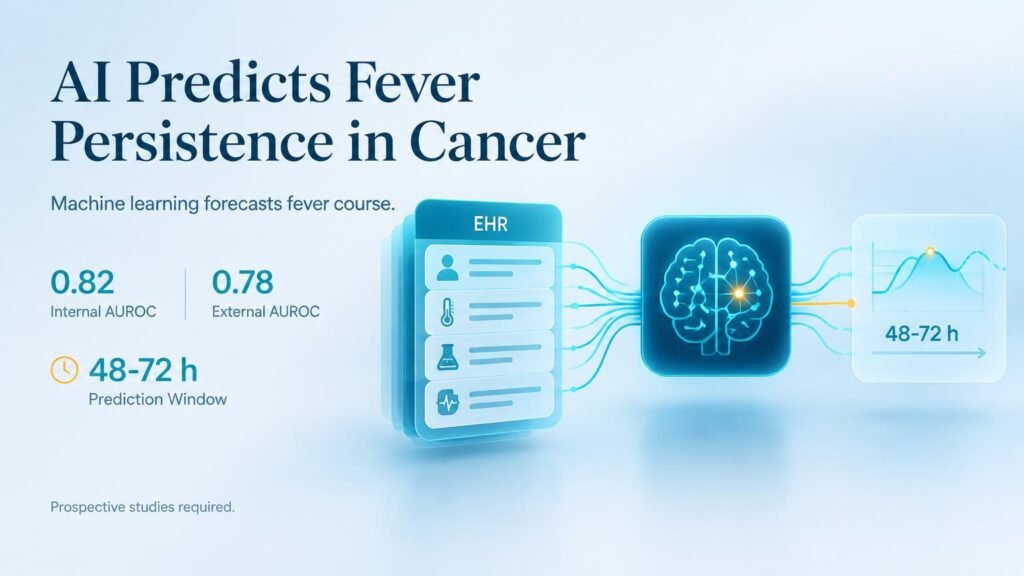
A new study demonstrates that machine learning models built on routine health records can accurately predict which patients will stop running a fever within 48 to 72 hours of starting treatment. That finding directly challenges the default instinct to automatically escalate therapy at the first sign of a lingering temperature.
By identifying patients who are unlikely to remain febrile, algorithms offer a counterweight to defensive medicine.
Predicting fever with routine data
Researchers developed and externally validated predictive models using electronic health record data from adult cancer patients across two academic hospitals. The study analyzed patients who experienced a fever within 24 to 48 hours after initiating IV antibiotics. The primary goal was predicting fever persistence at the 48-to-72-hour window, a key decision point for clinical reassessment.
The models processed standard clinical inputs, including demographics, comorbidities, laboratory values, vital signs, and trajectory patterns of body temperature. Temperature-related variables emerged as the strongest predictors of whether a fever would persist.
The model performance remained robust across separate hospital systems:
- Internal validation achieved an AUROC of 0.82 (95% CI 0.79–0.84).
- External validation at an independent academic hospital yielded an AUROC of 0.78 (95% CI 0.77–0.79).
- Decision curve analysis confirmed positive net clinical benefit across a wide range of decision thresholds.
- Retrospective mapping showed that approximately 25% of antibiotic escalations and chest CT scans were performed on patients correctly predicted not to remain febrile.
Operational limits and practical takeaways
High predictive accuracy in a retrospective dataset is not proof of safety. A model that performs well on historical charts cannot automatically replace physician judgment or guarantee that withholding treatment will not harm a vulnerable patient.
The study authors emphasize that this algorithm must act strictly as an adjunctive tool during reassessments rather than a standalone rule-out mechanism. Retrospective analyses cannot account for subtle clinical cues observed at the bedside, nor do they measure real-world clinician compliance and workflow integration.
The practical implication for hospitals is concrete. Predictive fever models should be tested as decision-support alerts to pause unneeded antibiotic swaps and imaging, but adoption must wait for prospective trials evaluating safety, uptake, and real-world clinical impact.
Read the full study in npj Digital Medicine.