
A flexible deep learning model bypasses strict electrode requirements to analyze sleep patterns at sub-30-second resolutions across diverse clinics.
For decades, sleep medicine has categorized sleep in rigid 30-second epochs. This standard exists because human scorers need manageable intervals, not because human biology operates on a half-minute timer. By forcing continuous physiological signals into 30-second blocks, clinical sleep studies routinely blur brief micro-arousals and transient neural shifts.
That compromise may no longer be necessary. A deep neural network named AnySleep demonstrates that automated sleep staging can drop fixed hardware constraints while offering finer temporal resolution.
Breaking rigid channel requirements
Multi-center sleep research frequently stalls due to hardware differences between laboratories. Variations in electrode counts, montages, and subject traits make cross-site data pooling notoriously difficult. Previous automated architectures, such as SleepEEGNet, relied on specific channel sequences, while specialized models targeted single-channel setups like ambulatory forehead EEG. However, these fixed models struggle when real-world clinical data lacks a specific required input.
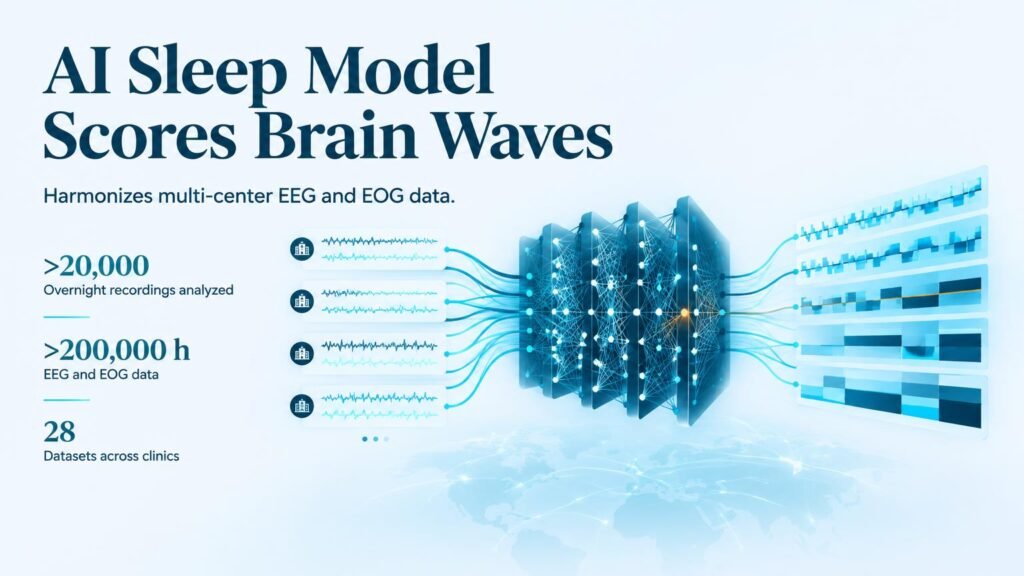
AnySleep addresses this bottleneck through a channel-agnostic design. Researchers trained and validated the model on more than 20,000 overnight polysomnography recordings representing over 200,000 hours of signal data drawn from 28 clinical datasets. The system maintains high accuracy regardless of whether it receives full montages, EOG data alone, or a single frontal, central, or occipital EEG derivation.
Sub-epoch resolution improves pathology detection
The operational value of this flexibility becomes obvious when evaluating time scales shorter than 30 seconds. By analyzing physiological signals at flexible sub-epoch intervals, the neural network isolates short wake intrusions consistent with sleep arousals that standard scoring routinely smooths over. This finer timescale directly improves predictive power for underlying clinical conditions.
- Diagnostic precision improved for obstructive sleep apnea, narcolepsy type 1, and insomnia when moving from 30-second epochs to sub-30-second scoring.
- Channel resilience preserved model performance even when EOG signals were absent or when input was restricted to a single EEG derivation.
- Cohort generalization succeeded across 28 distinct datasets comprising diverse subject characteristics and hospital montages.
Limits and practical takeaway
High accuracy on retrospective multi-center data does not guarantee improved patient outcomes. Redefining sleep staging timescales changes how clinicians quantify brief wakefulness, which could complicate diagnostic thresholds and reimbursement coding before established guidelines adapt. Until prospective clinical trials confirm that sub-30-second staging improves treatment choices, healthcare systems should use these tools to accelerate biomarker research across pooled cohorts rather than replace certified sleep technologists.
Read the complete study in npj Digital Medicine.