

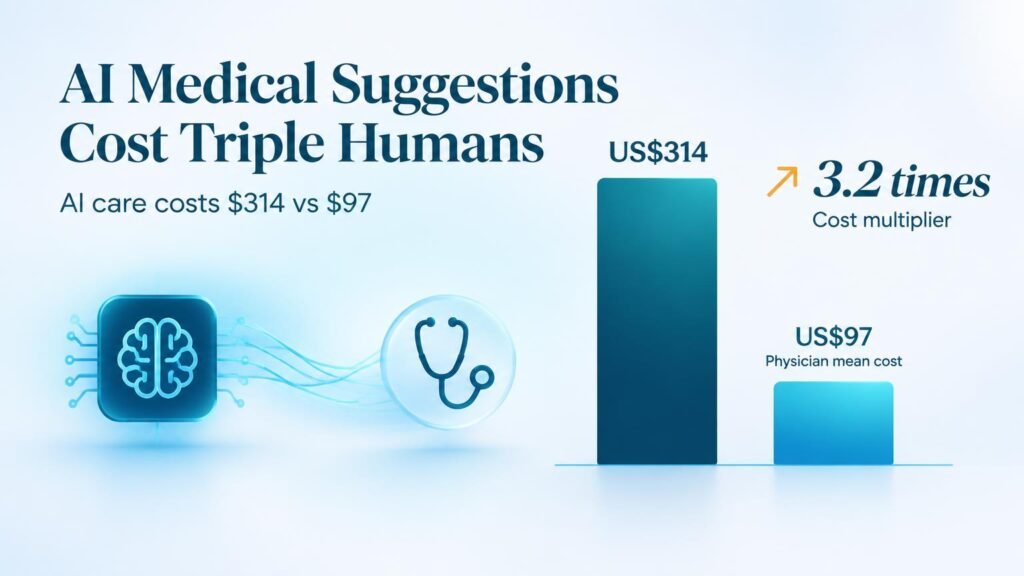
Large language models recommend clinical plans that cost more than triple what human physicians order, driven by defensive over-testing.
Deploying large language models as medical decision support could quietly balloon clinical spending. A study in NEJM AI evaluated 24 AI systems using 200 deidentified clinical notes from emergency and outpatient encounters. Instead of streamlining care, every system consistently recommended more expensive workups than treating clinicians.
Across 20 general-purpose AI systems, suggested care averaged $314 per visit priced at 2026 Medicare rates. Documented care from treating physicians averaged just $97 per visit. That creates a cost gap of $216 per visit, making AI suggestions 3.2 times as expensive as human care. As covered in Nature, automated clinical orders carry a steep financial markup.
This cost expansion exposes how algorithms operate without clinical risk tolerance. When human clinicians opt for watchful waiting, software defaults to defensive ordering.
Where the Money Goes
The financial excess split evenly between diagnostic testing and specialist care. Models averaged $105 more in diagnostic tests and $111 more in specialist referrals per visit. AI systems also recommended double the new medications, averaging 1.14 drugs per visit compared with 0.59 from physicians.
The contrast was sharpest during low-acuity encounters. Human physicians ordered zero diagnostic testing in 66% of visits. Every AI system suggested testing on those exact visits, routinely defaulting to stereotyped lab panels.
Domain-specific tuning failed to solve the problem. Four specialized medical AI systems generated orders costing 2.7 to 3.5 times more than physician care. Individual AI system mean costs spanned a wide range from $209 to $599 per patient.
Prompts Lower Spending Gap
Prompt engineering reduced spending recommendations without eliminating the baseline excess. Adding a cost-aware prompt lowered average AI costs to 2.5 times physician levels. A parsimonious-but-safe prompt brought spending down to 1.4 times physician care, though orders remained consistently higher than human baselines.
The study relies on synthetic cost extraction from historical notes rather than real-world billing or patient health outcomes. As researchers noted in NEJM, evaluating clinical AI requires benchmarking tools against actual human practice rather than abstract ideals.
Key findings from the economic evaluation include:
- AI diagnostic orders added an average of $216 in excess costs per encounter.
- Specialized medical models remained 2.7 to 3.5 times costlier than treating clinicians.
- Targeted prompts cut excess costs down to 1.4 times physician baselines but failed to match human restraint.
Unchecked AI recommendations risk flooding health systems with low-value lab panels and unnecessary specialty referrals. Until models calibrate risk like experienced doctors, health systems must keep algorithms in draft mode. Read the full trial in NEJM AI.