
A deep learning model elevated non-specialist x-ray interpretation to expert levels for detecting hip bone damage.
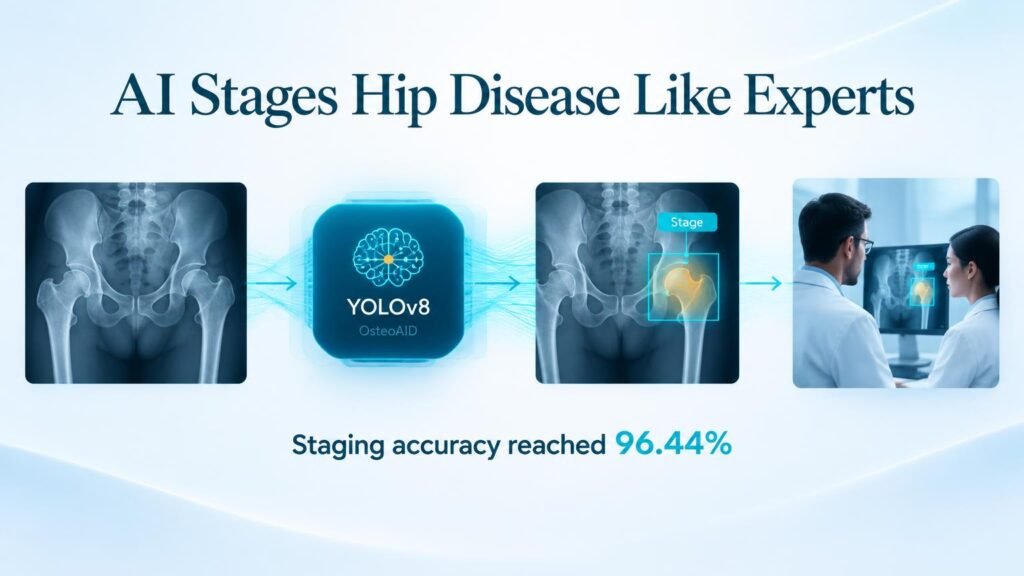
Detecting osteonecrosis of the femoral head early often requires costly MRI scans or rare specialist insight. Missed early signs lead directly to joint collapse and total hip replacement. A specialized deep learning model called OsteoAID now demonstrates that basic x-ray scans can deliver expert-level disease staging.
That performance could change how primary care clinics triage hip pain.
Massive multi-center training dataset
Researchers trained the algorithm on 20,722 anteroposterior hip x-rays gathered from 16,399 patients across six Chinese tertiary hospitals between 2015 and 2023. The dataset covered 28,785 individual hips, spanning healthy joints, confirmed necrosis cases, and lookalike conditions. Expert orthopaedists established the diagnostic ground truth using the Ficat and Arlet staging system.
Closing the specialist accuracy gap
On internal testing, OsteoAID boosted staging accuracy to 96.44% compared to 87.42% for standard YOLOv8 software. On external validation sets, the algorithm achieved a 96.60% staging accuracy. This performance surpassed general radiologists at 74.96% and junior orthopaedists at 83.98%, while matching senior experts who scored 96.54%.
Clinician assistance produced immediate accuracy gains. General radiologists improved their diagnostic accuracy by an absolute 21.47% when using the tool, while junior orthopaedists gained 12.70%. The software also maintained a 93.76% accuracy on challenging image sets containing poor contrast, improper exposure, and smartphone photos of physical films.
- Diagnostic evaluation time dropped across all clinician experience levels when using model assistance.
- Algorithm performance paired with x-rays matched MRI-staged controls with an overall accuracy of 96.63% and AUC of 97.33%.
- Detection sensitivity achieved a mean average precision of 92.97% on internal benchmarks.
Real-world trial hurdles remain
These findings show that software can extract specialist-grade insights from cheap, accessible imaging. However, retrospective accuracy does not prove that software deployment will alter clinical decision-making or improve surgical outcomes. Prospective trials must now verify whether automated x-ray screening actually reduces unnecessary MRI referrals and prevents late-stage hip joint collapse in high-volume clinics.
Read the full study in The Lancet Digital Health.