

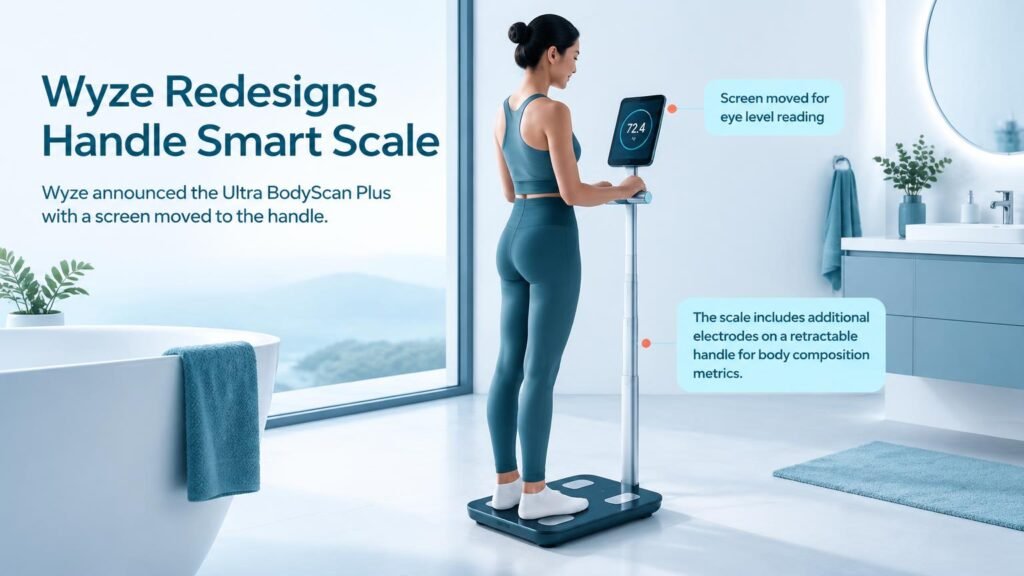
Moving bioimpedance displays from the floor to eye level signals a broader commoditization of advanced home health metrics.
From Floor to Handle
Reading health metrics off a screen at your feet is an ergonomic flaw of traditional smart scales. Relocating a 4.3-inch display onto a retractable handle equipped with additional electrodes solves a basic usability hurdle.
This layout enables eight-electrode measurement across the arms, legs, and torso. Rather than relying solely on foot-to-foot bioelectric impedance, multi-segment scanning isolates localized body composition across 50 body metrics.
The Shift Away From Subscriptions
At $150, the main operational story is market pricing pressure. Competitors offering similar segmented scanning have increasingly tied granular trend data to ongoing monthly fees.
Removing software paywalls while exporting data directly to Apple Health and Google Health Connect directly challenges current hardware business models. Consumer health devices do not require recurring SaaS gatekeeping to deliver multi-segment tracking.
This hardware strategy broadens access for patient self-monitoring without adding recurring cost barriers.
Clinical Realities and Limits
Accessibility is not clinical equivalency.
Consumer bioimpedance scales remain highly sensitive to hydration status, meal timing, and skin temperature. While eight-electrode devices offer better relative trend monitoring than basic four-electrode units, bioimpedance cannot replace dual-energy X-ray absorptiometry (DEXA) for precise diagnostic body composition.
For care teams tracking remote patient trends, home multi-segment hardware offers better directional visibility than standard scales. However, clinicians must interpret these metrics as general longitudinal signals rather than precise diagnostic inputs.