
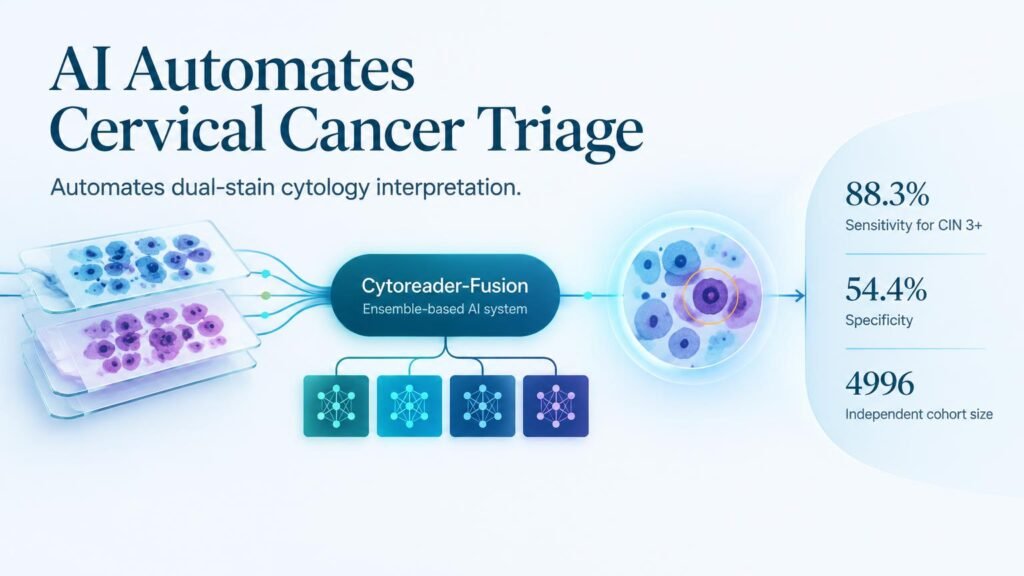
A locked AI algorithm successfully automates dual-stain cytology triage for cervical cancer screening, matching expert readers without requiring platform-specific retraining.
Human papillomavirus molecular testing detects cervical cancer risks early, but downstream triage still relies heavily on manual cytological evaluation. Human interpretation of p16/Ki-67 dual-stain slides suffers from reader variability and labor shortages, creating a bottleneck in high-volume screening programs.
A new study demonstrates that automated slide classification can bridge this operational gap. Researchers evaluated Cytoreader-Fusion, an ensemble-based AI model trained on 1,919 cases, to see if software could standardize slide-level triage across different preparation platforms.
Strong external validation
To test clinical generalizability, the algorithm was locked and evaluated across 9,006 cases in four independent cohorts. Crucially, performance was measured against histologically confirmed cervical intraepithelial neoplasia grade 3 or worse (CIN 3+), rather than simple agreement with human pathologists.
In the primary external validation cohort of 4,996 cases, the locked model held up without any threshold adjustments or retraining. It processed both ThinPrep and SurePath slide preparations using a single unified classifier.
That lack of platform dependence is the critical milestone.
Standardizing triage protocols across varying preparation methods remains a persistent challenge for cervical screening in high-income countries, where workflow integration often stalls over slide preparation differences.
Key performance metrics
The study showed that automated triage met or exceeded traditional manual evaluation standards across several parameters:
- Achieved 88.3% sensitivity for detecting CIN 3+ in the post-lock validation cohort.
- Maintained 54.4% specificity across diverse clinical screening populations.
- Outperformed standard atypical squamous cells of undetermined significance or worse Pap cytology cutoffs.
- Delivered consistent operating characteristics across distinct imaging environments without model recalibration.
These metrics demonstrate that automated dual-stain triage can remove manual reading bottlenecks while preserving diagnostic accuracy. The findings support ongoing industry efforts to incorporate advanced molecular tools alongside HPV mRNA testing modalities in modern preventive care.
Limits to clinical deployment
Despite these diagnostic metrics, retrospective validation does not guarantee improved patient outcomes. Prospective clinical trials are still required to measure how automated slide reading alters diagnostic turnaround times, colposcopy referral efficiency, and total clinician workload.
Additionally, a specificity of 54.4% means nearly half of patients without high-grade lesions still clear the triage threshold, requiring downstream management. Clinical laboratories evaluating this tool must weigh these referral rates against their local capacity before integrating automated triage into routine workflows.
Read the full study in NEJM AI.