
Automated triage and follow-up tools improve chronic disease management for older adults, but only when clinic staff bridge the digital divide.
Deploying diagnostic algorithms to community clinics often fails to translate into real patient benefits. A matched observational study from Guangdong Province demonstrates that software embedded into primary care workflows can lower patient admissions, provided clinic staff guide patients through the technology.
To evaluate these systems, researchers analyzed a matched sample of 420 older adults living with chronic conditions. The analytic cohort was split evenly between 210 patients treated at AI-enabled primary care clinics and 210 patients at standard comparison facilities. To understand how these tools worked on the ground, the authors also interviewed 48 medical staff and institutional managers.
Stronger control and lower admissions
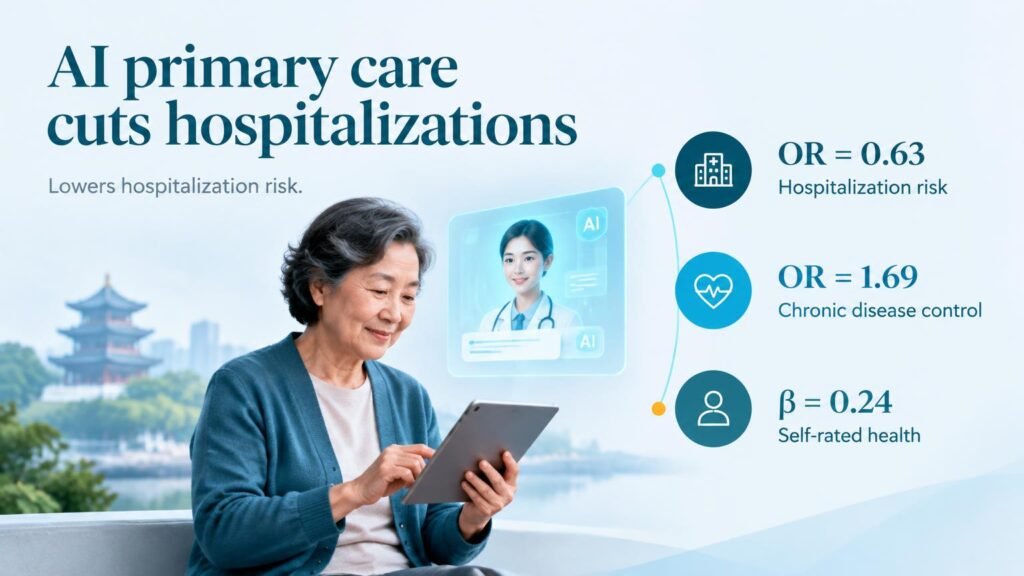
The quantitative data showed significant improvements across key health metrics for patients attending institutions equipped with automated patient guidance, triage, and follow-up tools. Rather than simply speeding up administrative tasks, the software was associated with concrete clinical gains.
- Chronic disease control rates rose noticeably (OR = 1.69, 95% CI: 1.12–2.56).
- Self-rated health scores shifted upward across the intervention group (β = 0.24, 95% CI: 0.08–0.39).
- Overall risk of hospitalization decreased by over a third (OR = 0.63, 95% CI: 0.39–0.99).
These figures align with broader findings on the adoption of artificial intelligence in primary health care, confirming that clinical triage algorithms can stabilize vulnerable chronic disease cohorts before medical events turn critical.
The human mediator factor
Subgroup analyses showed that the health benefits were most pronounced among low-income and low-education patients. Yet digital literacy presented a strict boundary condition. Low-literacy patients could not interact with the digital platforms independently.
Algorithms alone did not reduce health disparities.
Staff interviews revealed that older patients relied heavily on health workers to navigate digital platforms. Improved health information acquisition and service access only occurred when staff actively mediated the technology. As established in past research on digital health care in China, elderly populations require hands-on support to benefit from modern medical software.
Observational bounds and takeaway
The study design carries clear limitations. Matched observational data cannot establish direct causality, and regional sampling in Guangdong limits how easily these results translate to other health systems.
Health administrators looking to deploy digital triage tools must avoid treating software as a substitute for human labor. Algorithmic primary care delivers clinical value only when clinics fund the front-line staff needed to run human-assisted care models.
Read the full paper in Frontiers in Public Health.