
Breaking AI responses into single statements catches critical medical errors that standard retrieval systems miss.
Retrieval-augmented generation promised to stop large language models from inventing medical facts. It fell short. Even when grounded in guidelines, AI models still weave subtle hallucinations into long-form medical answers.
That failure exposes a core flaw in current clinical AI strategy. Evaluating full paragraphs at once hides false statements inside fluent prose.
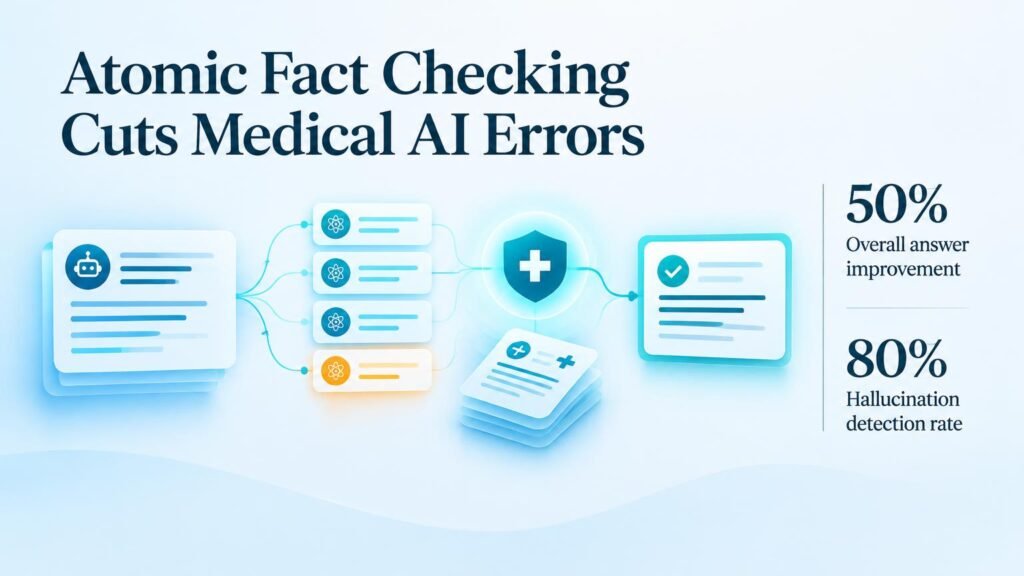
A study in the Journal of Medical Internet Research proposes a better approach: breaking every generated answer into its smallest self-contained units of information. By verifying these atomic facts individually against guideline databases, the system pinpoints and rewrites false claims before a doctor sees them.
Testing Claim-Level Verification
Researchers built an automated pipeline that decomposes generated responses into discrete atomic facts. The algorithm compares each fact against an authoritative knowledge base of clinical guidelines, automatically correcting statements labeled as false.
The team evaluated paired open-source models, comparing generalist systems against their medically fine-tuned equivalents. Validation relied on multireader human expert reviews and the Autonomous Medical Evaluation for Guideline Adherence benchmark, known as AMEGA.
Testing covered multiple clinical areas to test broad applicability. The researchers used prostate cancer treatment Q&As, a radio-oncology test set, anonymized real-world tumor board cases, and an established neurology dataset.
Key Performance Metrics
The atomic checking framework delivered measurable gains across every dataset evaluated:
- The pipeline achieved up to an 80% hallucination detection rate.
- Correcting false facts yielded up to a 50% overall answer improvement.
- The highest accuracy gains occurred in complex, real-world tumor board cases.
- The framework provided granular explainability by linking each atomic fact to specific source chunks.
What Changes for Clinical AI
The performance boost on real tumor board cases carries the most important operational lesson. Complex, multi-system clinical questions usually trigger the highest error rates in language models. Proving that automated claim-level verification performs best on hard cases challenges the idea that fine-tuning alone can guarantee clinical safety.
Traceability also changes how institutions address compliance. Linking discrete facts directly to guideline source chunks gives clinicians explicit justification for every recommendation rather than an opaque paragraph.
Yet these findings reflect retrospective accuracy, not patient outcomes. High accuracy on static question sets does not prove the system reduces clinician workload or prevents diagnostic errors in real time. Until prospective clinical trials measure workflow impact, atomic fact-checking remains a validation filter rather than proof that AI can replace human oversight.
Read the full research in the Journal of Medical Internet Research.