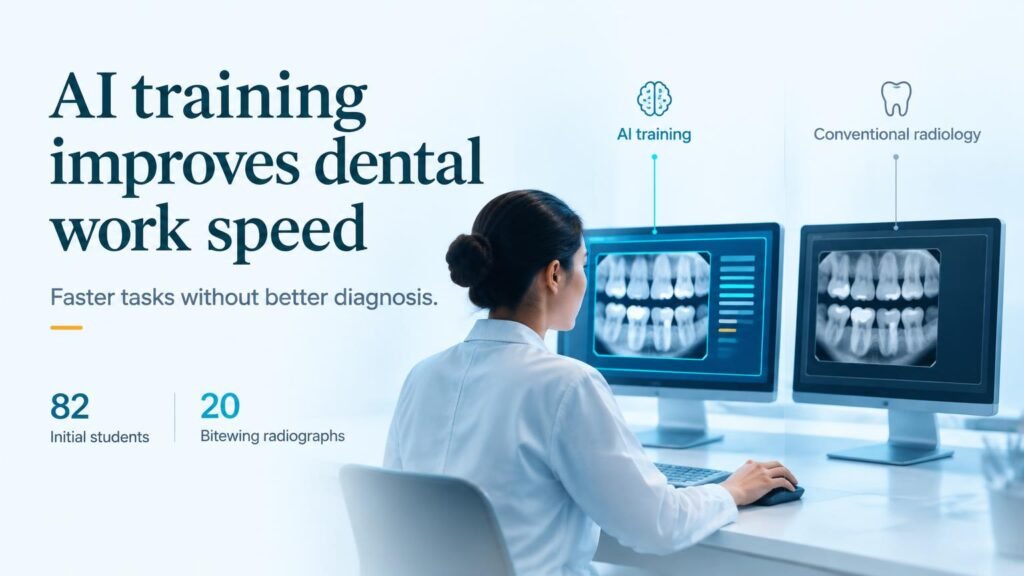
AI radiology software speeds up student diagnostics, but it does not make novice clinicians any better at detecting tooth decay on their own.
Dental educators hoping commercial software will turn trainees into expert diagnosticians need to lower their expectations. In a randomized trial evaluating undergraduate dental students, short-term AI training failed to lift unassisted diagnostic accuracy above traditional instruction. What the software delivered instead was clinical efficiency and tighter consistency when judging lesion depth.
That distinction matters for dental schools weighing costly software licenses.
The trial enrolled 82 undergraduate dental students, with 79 completing both stages. Researchers randomly assigned 41 students to receive a one-hour radiology session using Second Opinion® software, while 38 students received conventional radiology training. Participants completed pre- and post-tests consisting of 20 conventional bitewing radiographs, evaluating three proximal surfaces per image.
Diagnostic performance was calculated on a total exact-match score from 0 to 60 and an absolute average error scale from 0 to 5. Crucially, the post-test occurred one day later without any AI support.
Key study findings
- No accuracy gap: Exact-match diagnostic scores showed no statistically significant difference between AI and conventional training groups across time points (p > 0.05).
- Worsening conventional errors: Absolute average errors increased significantly in the conventional group from pre- to post-test (p < 0.05), indicating greater deviation from correct answers.
- Faster completion times: Post-test completion times were significantly shorter for the AI group compared to the conventional cohort, with both groups speeding up overall (p < 0.05).
Efficiency over mastery
The findings complicate the narrative that AI software teaches superior diagnostic habits. When the algorithms were turned off, students trained on AI performed no better at identifying exact caries extension than those trained on standard radiographs. The technology did not turn novices into sharper visual interpreters.
However, AI training did protect students from diagnostic drift. While conventional trainees grew less precise from pre- to post-test, the AI cohort maintained tighter estimations of lesion depth while completing the task significantly faster.
Limitations and realistic adoption
The trial carries clear operational limitations. Evaluating students one day after a single one-hour session reflects short-term recall, not long-term diagnostic competency or clinical performance. Furthermore, measuring radiograph reading speed on a test does not directly equate to improved patient health outcomes or reduced workload in active dental clinics.
Dental schools should view AI software as an operational efficiency aid rather than a replacement for foundational radiology instruction. The software helps trainees calibrate their judgment and work faster, but core diagnostic training still requires human instruction.
Full details were published in BMC Medical Education.