Clinicians are quietly adopting generative AI for administrative tasks while deeply distrusting the tech companies building these tools to police themselves.
Silicon Valley wants doctors to trust artificial intelligence with patient care. Yet the clinicians actually using these tools are drawing a sharp line between administrative help and clinical decision-making. They are happy to let models summarize papers, but they do not trust tech companies to oversee the technology.
This disconnect threatens to stall deep clinical integration. If developers do not cede oversight to medical boards, adoption will hit a hard ceiling of administrative busywork. Clinicians are willing to experiment, but they refuse to outsource their professional judgment to third-party software vendors.
Where doctors use AI
A new survey of 335 health care professionals reveals a stark divide in how AI enters the clinic. The cohort consisted mostly of attending physicians (68.7%, n=230), alongside residents, fellows, nurse practitioners, and researchers. Most respondents were aged 30 to 59 (72.5%, n=243) and practiced in the Northeast United States (77.9%, n=261).
Among this group, 62.7% (n=210) currently use or plan to use large language models (LLMs). But they are not using them to diagnose patients. Instead, they favor low-risk tasks. This cautious approach aligns with broader industry warnings about the potentials and pitfalls of medical LLMs.
What clinicians actually want
The survey highlights a clear preference for administrative assistance over automated clinical judgment.
- 73.4% (n=246) value LLMs for literature reviews, while only 57% (n=191) support their use for clinical decisions.
- 75.5% (n=253) fear critical decision errors, and 73.1% (n=245) worry about algorithmic bias.
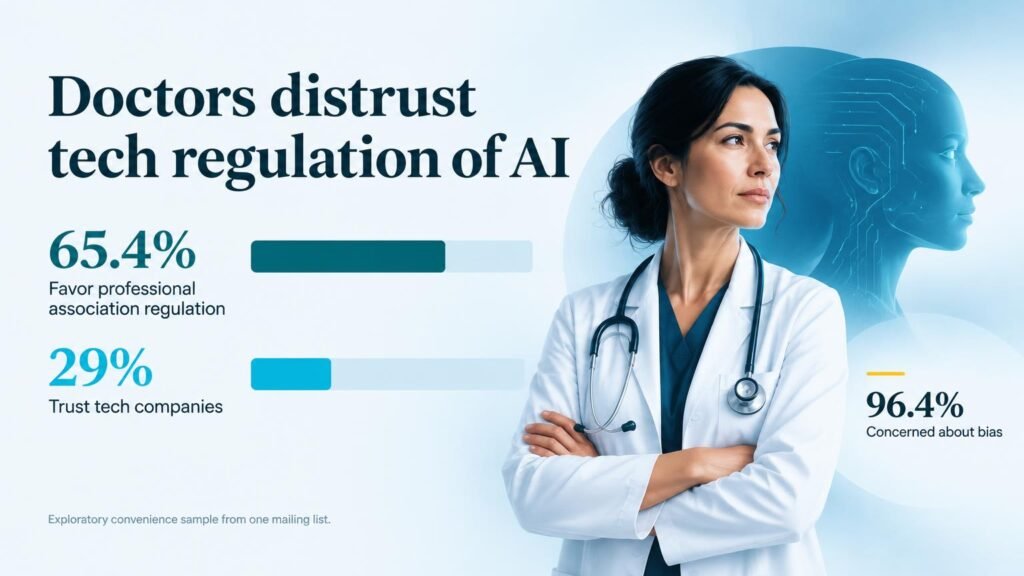
- 96.4% (n=323) expressed general concern about bias, which spiked significantly among those who had personally witnessed it.
- 65.4% (n=219) want professional medical associations to regulate these tools, compared to just 29% (n=97) who trust tech companies.
The trust gap
The message is clear. Clinicians do not want tech companies grading their own homework. An overwhelming 66.6% (n=223) of respondents reported zero confidence in existing AI oversight. This lack of trust explains why many argue that prompt engineering must become a core medical skill so clinicians can audit these systems themselves.
We must view these findings with caution. The data comes from a convenience sample on a health-innovation mailing list, meaning these respondents are likely more tech-savvy than the average doctor. The heavy geographic bias toward the Northeast United States also limits how well these views represent rural or community clinics.
For health systems, the takeaway is practical. Do not wait for federal regulators or tech vendors to set the rules. To drive safe adoption, local clinical leaders must design their own peer-led auditing systems.
Read the full study in the Journal of Medical Internet Research.