
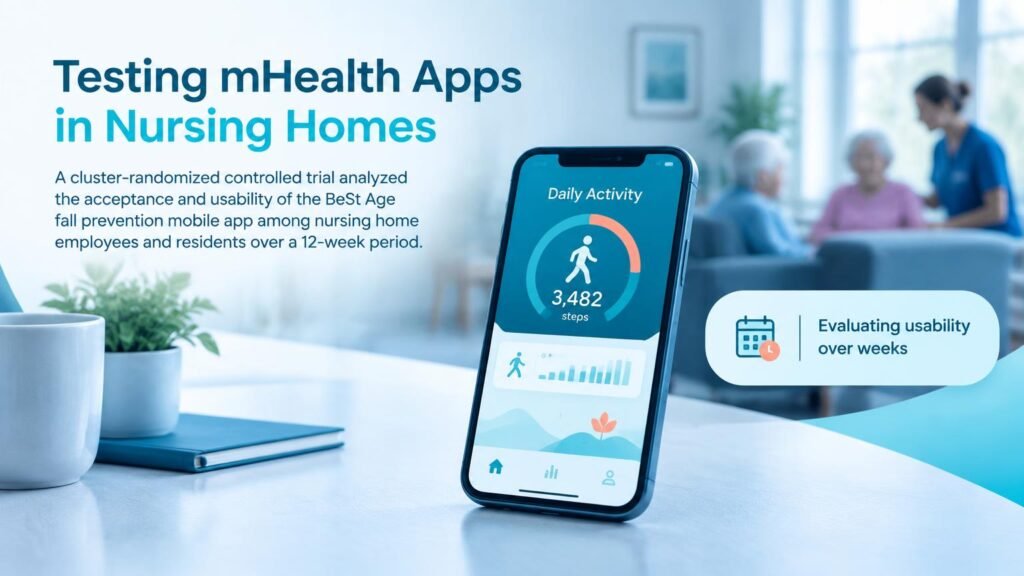
Digital health tools can train elderly bodies, but changing actual clinical outcomes in nursing homes requires more than a 12-week app intervention.
A trial across 19 nursing homes testing the BeSt Age app highlights the gap between surrogate clinical markers and real-world safety. While the tablet-guided program successfully improved residents’ balance, it failed to reduce overall fall incidence or ease the fear of falling during the 12-week study.
This discrepancy exposes a common friction point in mobile health deployment. Improving physical metrics in a controlled setting does not automatically translate to safer hallways.
The Adoption Friction
Staff-mediated digital tools are highly feasible to implement. Busy nursing home employees can easily integrate tablet exercises into daily routines, proving that usability is no longer the primary barrier to adoption.
Yet, the short timeframe of most clinical trials limits their ability to show hard outcome reductions. A broader meta-analysis suggests these tools can eventually lower fall risk by 11%, but capturing that change requires sustained, long-term tracking.
The Reality Check
Clinicians and administrators must distinguish between physical readiness and behavioral change. An app can guide a better squat, but it cannot re-engineer a resident’s environment or eliminate cognitive factors that lead to stumbles.
For digital health to mature, validation must move past short-term usability metrics. Providers should invest in these tools for mobility maintenance, not as an immediate fix for fall-related insurance claims. If an app improves balance but fails to reduce falls, it remains a partial clinical victory, not a systemic solution.