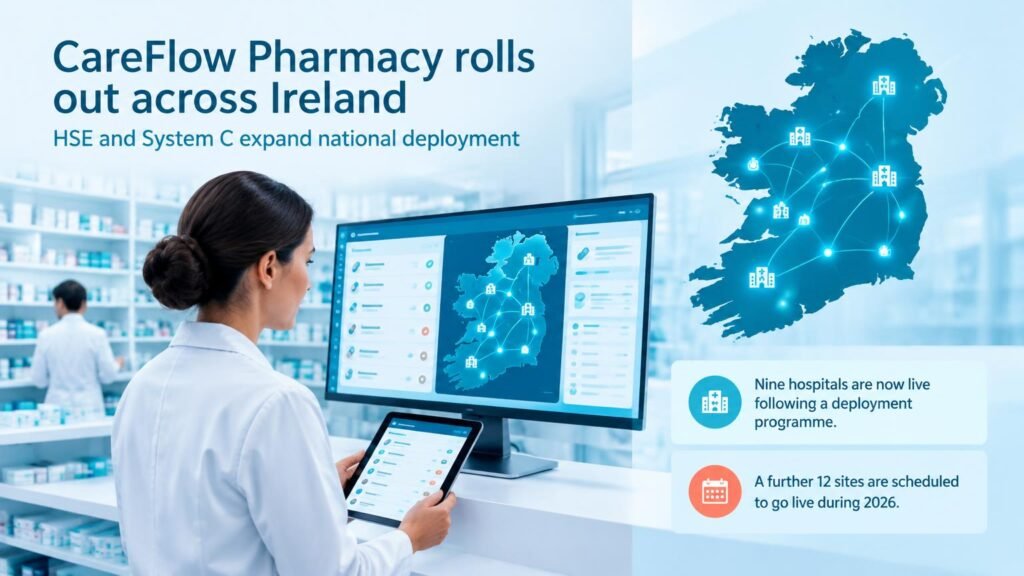
Replacing legacy software across 95 Irish pharmacy departments with a single national system exposes the friction between modernizing infrastructure and managing immediate operational disruption.
A national healthcare system is only as fast as its slowest legacy database. For years, Ireland’s hospitals operated on fragmented pharmacy software. This left critical medication, patient, and financial data trapped in localized silos, complicating procurement and patient transfers.
The ongoing rollout of a unified digital platform across approximately 95 acute and community pharmacy departments aims to solve this. By integrating with the Individual Health Identifier, the system establishes a single national patient record for medicines. This is a significant step for the country’s digital health framework.
The operational friction
Consolidating data reduces waste and lowers operational costs on paper. However, the true test lies in the transition phase. Nine hospitals are currently live, with 12 more scheduled for 2026. This multi-year deployment means clinicians must navigate a split reality. For several years, some facilities will use the new platform while neighboring clinics still rely on legacy setups.
The integration hurdle
While a single national record improves tracking, software integration does not automatically translate to better patient outcomes. Success depends entirely on staff adaptation and eliminating manual data entry errors during migration. The immediate consequence is an increased cognitive workload for pharmacy staff during the training and transition periods. True efficiency will only emerge once the legacy systems are fully decommissioned across all 95 sites.