We are rapidly moving past the era of AI as a simple dictation tool. This week’s developments show that clinical AI is stepping directly into autonomous decision-making, forcing us to confront massive questions about liability, validation, and hospital economics.
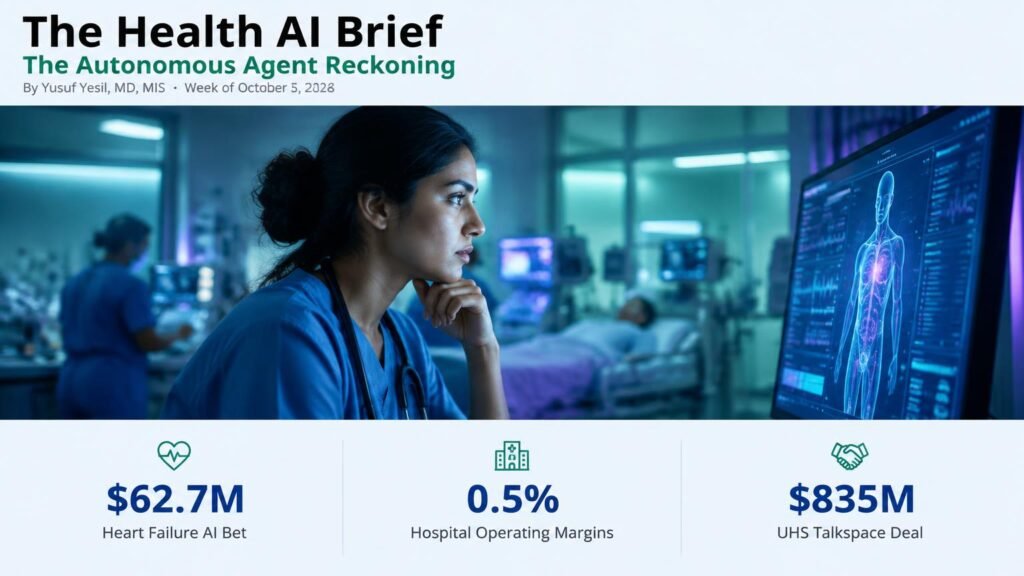
🔹 Anthropic Joins Federal Autonomous Heart Failure AI Project — A federal agency is betting $62.7 million that autonomous AI agents can safely manage heart failure patients without direct human oversight.
If you are building in this space, pay attention: this is a massive shift from passive clinical decision support to active, autonomous patient management. We need to watch how they handle liability when an agent adjusts medication without a doctor’s signature.
🔹 Why Hospital AI Projects Fail to Save Cash — Healthcare systems are pouring millions into artificial intelligence while operating margins hover at a near-invisible 0.5 percent.
When I was building Yesil Health, I realized that clinical efficacy is only half the battle; if your tool doesn’t directly reduce labor costs or prevent expensive readmissions, cash-strapped hospitals simply won’t buy it.
🔹 Institutionalizing Virtual Therapy: The UHS-Talkspace Deal — Universal Health Services is betting $835 million that virtual therapy can solve the costly bottleneck of psychiatric discharge.
For clinicians, this highlights how digital health is being used as an operational valve to free up physical beds, rather than just a standalone wellness app.