An ensemble machine learning model can standardise how clinicians predict kidney-threatening bladder complications in spina bifida patients, reducing subjective variation.
Pediatric urologists often disagree when reading videourodynamic (VUDS) tests for children with spina bifida. This subjectivity is dangerous. Misjudging bladder pressure can lead to silent, irreversible kidney damage.
A new external validation study shows that combining pressure data and imaging into a single AI model can bring consistency to these high-stakes decisions. It proves that algorithms trained at one institution can survive the transition to another.
The power of multimodal data
This validation challenges the industry’s reliance on single-modality diagnostics. By proving that an ensemble model outperforms isolated data streams, the study suggests that clinical AI must be multimodal to be useful. Why this matters is highly specific to spina bifida care. These patients require lifelong monitoring, and subjective test interpretations lead to inconsistent treatment plans over a child’s life. Standardising this pipeline protects long-term renal function.
The researchers adapted three deep learning frameworks to an independent dataset of patients treated at a single institution between 2016 and 2025. They tested the tools on predicting incident hydronephrosis (kidney swelling) and classifying bladder dysfunction severity. The ensemble model consistently outperformed individual diagnostic methods.
What the data shows
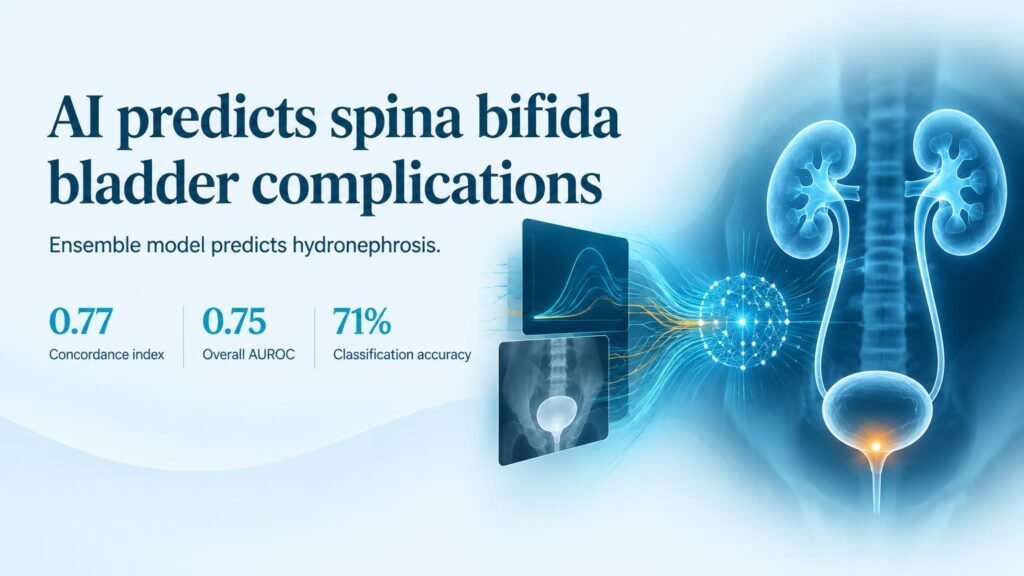
- In the hydronephrosis cohort of 70 patients, where 13 (18%) developed the condition, the ensemble model achieved a concordance index of 0.77.
- The ensemble’s overall AUROC was 0.75, compared to 0.67 for pressure-volume data alone and 0.74 for imaging alone.
- For classifying bladder dysfunction across 95 VUDS studies, the ensemble model reached 71% accuracy.
- This outperformed pressure-volume alone at 60% and imaging alone at 66%, with no substantial disagreements with expert reviewers.
Limits of the algorithm
We must be realistic about these numbers. An accuracy of 71% is a solid baseline, but it is not high enough to replace human experts. This was a retrospective evaluation using a small cohort at a single institution. Diagnostic accuracy in a historical dataset does not automatically translate to better patient outcomes in the real world.
The practical takeaway is not immediate automation. Instead, this tool should act as a digital safety net. It can flag high-risk patients who might otherwise be missed due to human interrater variability.
Read the full study in medRxiv.