Relying on simple heart pump measurements misses the chaotic scar tissue patterns that actually trigger fatal heart rhythms.
For decades, cardiologists have relied on left ventricular ejection fraction (LVEF) to decide who gets a life-saving defibrillator. It is a crude metric. Many patients with low LVEF never experience sudden cardiac arrest, while others with preserved function die unexpectedly. This study challenges the status quo by shifting the focus from how well the heart pumps to the physical texture of its scars.
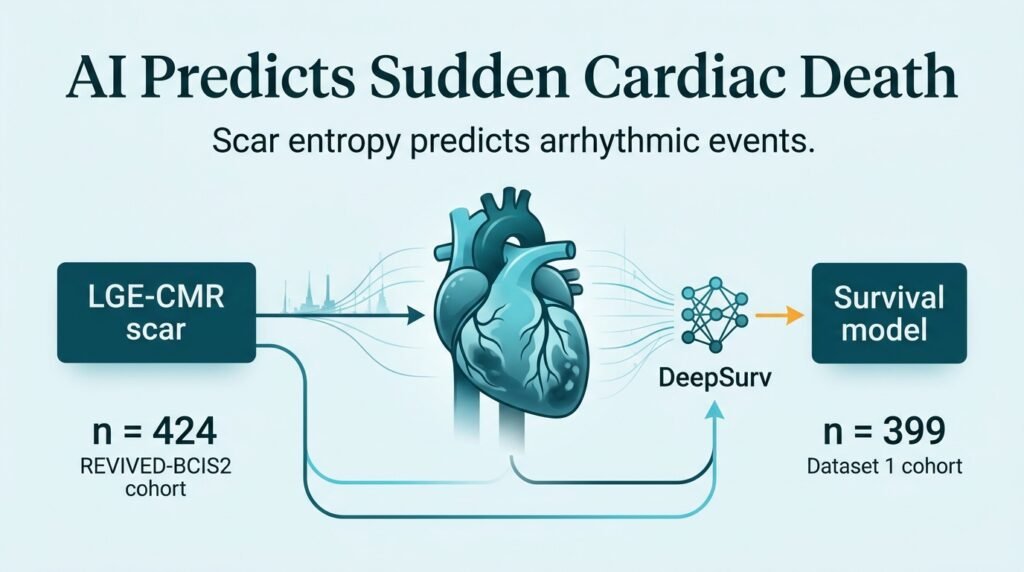
By feeding late gadolinium enhancement cardiac magnetic resonance (LGE-CMR) data into machine learning models, researchers proved that scar “entropy”—the complexity and chaos of scar tissue—is a far more precise predictor of arrhythmic death. This is not just a technical upgrade. It suggests that our current clinical guidelines are looking at the wrong biological signal. This shift aligns with previous research using deep learning to predict major arrhythmic events in dilated cardiomyopathy (PLoS ONE, 2024).
Testing the algorithms
The researchers tested their approach on two distinct ischemic heart disease cohorts. Dataset 1 included 399 patients with 54 major arrhythmic events. Dataset 2, pulled from the REVIVED-BCIS2 trial, tracked 424 patients and recorded 50 events. Grouping these cohorts allowed researchers to test how well the algorithms could handle real-world variation.
Instead of standard linear statistics, the team deployed non-linear machine learning models. DeepSurv, a deep learning-based survival model, showed the best ability to generalize its predictions across the different patient groups. Meanwhile, Random Survival Forests proved highly robust in pooled analyses.
- Scar entropy consistently outperformed traditional clinical markers as a predictor of sudden death.
- Non-linear machine learning models significantly beat traditional Cox proportional hazards regression.
- DeepSurv successfully generalized predictions across two independent cohorts totaling 823 patients.
- The models successfully processed LGE-CMR-derived variables to map scar heterogeneity.
Beyond simple pump metrics
This finding changes how we think about risk. Defibrillators are expensive, invasive, and carry risks of inappropriate shocks. By pinpointing scar chaos, clinicians can better target these devices to patients who truly need them, rather than relying on a blunt LVEF cutoff. Similar deep learning approaches on contrast-enhanced cardiac MRI have shown promise in predicting sudden cardiac death survival in other cohorts (Heart Rhythm, 2022).
However, the study has limitations. These retrospective analyses rely on existing datasets and have not yet been tested in a real-time, prospective clinical trial to see if AI-guided decisions actually save more lives. Until we have prospective outcomes data, these algorithms remain powerful diagnostic assistants rather than clinical decision-makers.
Read the full study in npj Cardiovascular Health.