
We are seeing a major shift in clinical machine learning: high benchmark scores no longer guarantee real-world performance. If you are building or deploying AI in a clinic next week, these three cases show why we must design for messy workflows, not perfect datasets.
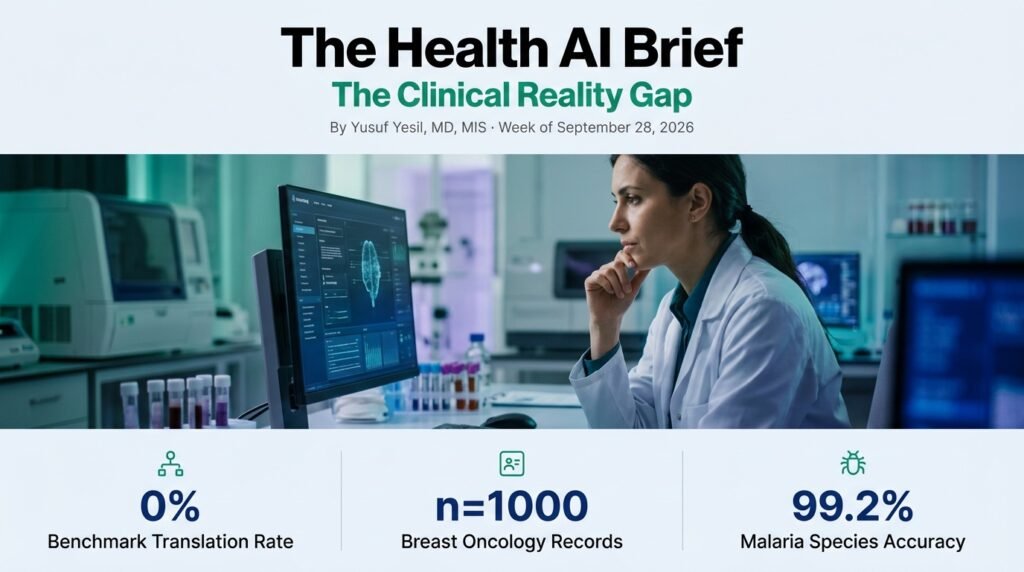
🔹 Top Performing AI Fails Clinical Reality Check — A new study reveals that training AI to ace medical benchmarks actually makes its clinical reasoning worse.
When I was building Yesil Health, I noticed that optimizing strictly for test datasets often blinds models to edge cases. If you are building clinical tools, stop chasing perfect benchmark scores and start testing for logical consistency under pressure.
🔹 Fully Automated Abstraction of Oncology Records — Off-the-shelf artificial intelligence can now parse thousands of pages of messy medical records to build research-grade datasets.
This is a massive win for clinical trial builders who spend months manually extracting data. It proves that you do not always need custom-built, multi-million dollar clinical models when a properly prompted LLM can match an oncologist’s accuracy.
🔹 AI identifies malaria species in blood smears — A new hierarchical deep learning framework separates malaria species from healthy cells with near-perfect accuracy.
For clinicians working in resource-constrained environments, this is highly practical. The technical beauty here is how the model handles imbalanced datasets, which is the exact reality of field medicine.