
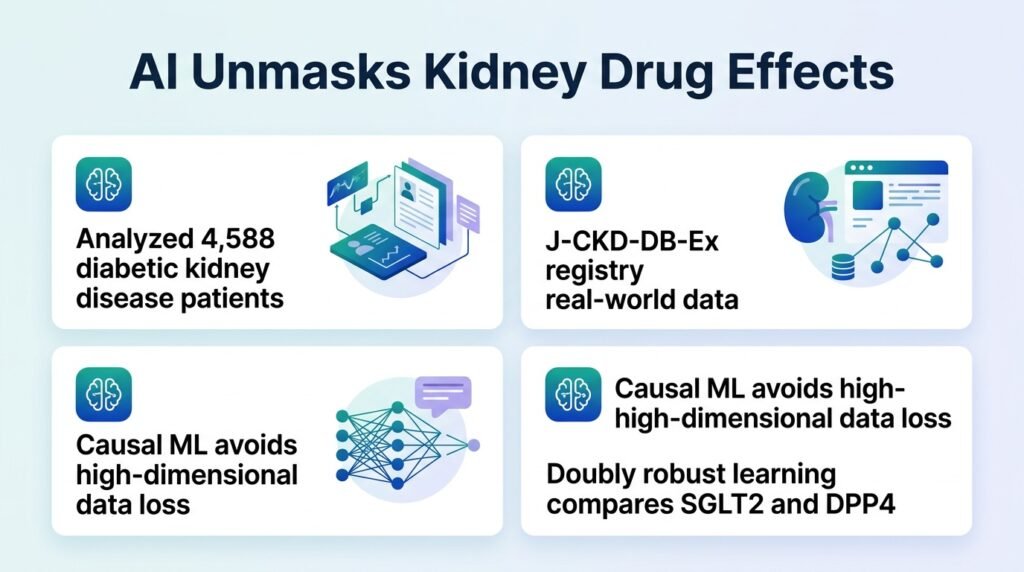
A new causal machine learning analysis reveals that standard population-level prescribing guidelines for diabetic kidney disease are masking critical, individual-level treatment failures.
For years, clinical guidelines have treated diabetic kidney disease as a monolith, increasingly positioning SGLT2 inhibitors as a blanket victory over older drugs. But what if the average benefit reported in clinical trials is hiding a subset of patients who actually decline faster on the newer therapy?
This study challenges the industry’s rush toward uniform prescribing. By using causal machine learning instead of blunt statistical averages, researchers exposed a stark reality: the optimal drug choice depends entirely on a patient’s specific clinical baseline. It forces us to rethink the clinical habit of abandoning older drug classes for the latest blockbuster therapy.
Averages hide individual risks
Traditional real-world studies rely on propensity score matching to compare drugs. This method causes high-dimensional data loss, effectively throwing away valuable patient characteristics to make comparison groups look identical. To bypass this limitation, researchers applied a doubly robust learning framework with XGBoost to analyze data from 4,588 patients within the Japanese J-CKD-DB-Ex registry.
At the population level, SGLT2 inhibitors appeared to offer only a minor advantage over DPP4 inhibitors. They modestly slowed chronic eGFR decline by an average treatment effect (ATE) of just 0.14 mL/min/1.73m²/year. They also reduced the risk of a composite renal endpoint—defined as a 50% or greater eGFR decline or end-stage kidney disease—by a modest 9% (ATE: -0.09).
These population-level averages suggest SGLT2 inhibitors are a marginal upgrade. However, the individual-level counterfactual analysis proved that the average lies.
Mapping the treatment split
The machine learning model revealed that a patient’s pre-existing drug regimen and kidney trajectory dictate which drug actually works. For some patients, SGLT2 inhibitors are vastly superior, while for others, they are the wrong choice.
- Non-glinide users with stable pre-treatment trajectories who were also taking ACE inhibitors saw a major benefit from SGLT2 inhibitors, with an eGFR slope ATE of 2.95.
- Glinide users with a steep pre-treatment decline fared much better on older DPP4 inhibitors, showing an ATE of -8.98.
- High-risk patients with an eGFR of 28.1 mL/min/1.73 m² or less and positive proteinuria experienced a massive 28% absolute risk reduction (ATE: -0.28) with SGLT2 inhibitors.
Even patients without protein in their urine who were actively declining still saw an 8% risk reduction (ATE: -0.08) when prescribed SGLT2 inhibitors. The data shows that the newer drugs are highly effective, but only when targeted to the correct physiological profile.
The limits of prediction
This matters because it provides clinicians with concrete, algorithmic thresholds to replace clinical guesswork. Instead of prescribing SGLT2 inhibitors to everyone, doctors can target them to patients who meet the exact high-risk criteria—like the eGFR threshold of 28.1—where the drug delivers its maximum 28% risk reduction.
However, we must acknowledge the study’s limitations. This analysis is a retrospective preprint based on a Japanese registry, meaning these specific algorithmic thresholds must be validated in geographically diverse cohorts before they can safely alter daily clinical practice.
Read the full preprint in medRxiv.