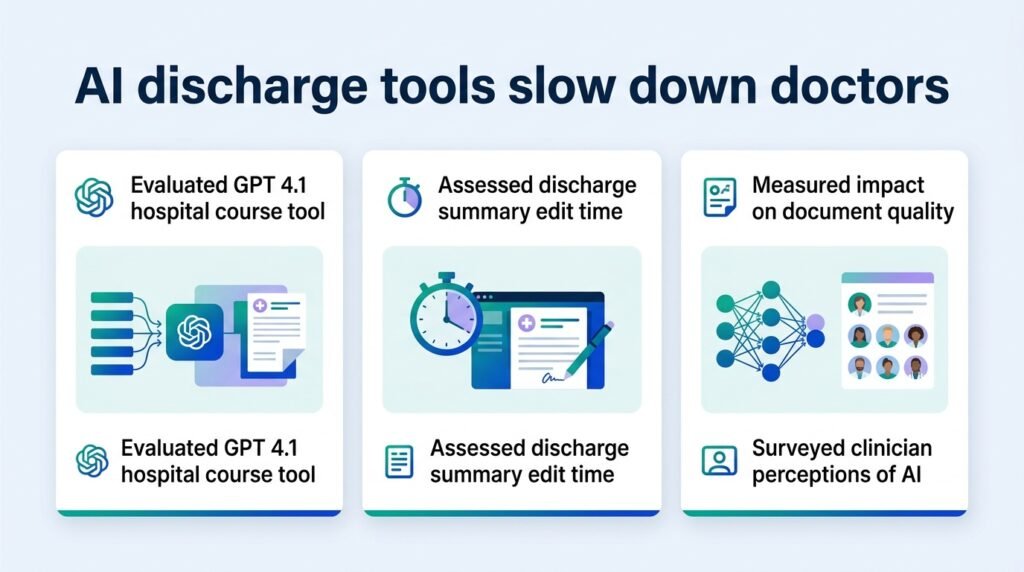
A new study reveals that while clinicians believe AI saves them time on discharge summaries, the technology actually increases their editing workload by nearly a third.
How do we measure clinical efficiency? Hospital administrators assume that feeding patient data into a large language model will automatically slash administrative burdens. But a new study reveals a striking psychological trap: doctors feel faster when using AI, even as the clock proves they are working slower.
This disconnect challenges the entire push for automated clinical documentation. If we measure success by subjective surveys, the AI is a triumph. If we measure it by actual keyboard time, it is a bottleneck.
The time paradox
Researchers tracked 8,298 hospitalized adults cared for by hospital medicine clinicians. They compared a pre-AI period (March 16, 2025 to November 19, 2025) to a post-AI period (November 20, 2025 to February 11, 2026) using a GPT 4.1 model integrated into discharge templates. The overall comparison between the two eras showed no statistically significant drop in edit times, moving from 6.60 minutes to 6.28 minutes.
But when the researchers looked specifically at the post-AI period, a stark contrast emerged. When clinicians actually used the AI tool, their edit time jumped to 9.20 minutes, compared to just 4.93 minutes when they wrote summaries without it. After adjusting for confounding factors, using the AI was linked to a 32% increase in edit time (95% CI 24%–41%, adjusted R² = 0.34).
Perception versus reality
Despite this extra work, the subjective feedback was overwhelmingly positive. Out of 36 surveyed clinicians, 31 (or 86.1%) agreed the tool improved their efficiency.
This is the placebo effect of clinical AI. Doctors hate starting from a blank page, so editing a draft feels easier than writing from scratch. Yet correcting AI errors and trimming bloated text takes more physical time than typing a brief note. This mirrors findings from a 2025 study on clinical note summarization systems, which highlighted the hidden cognitive load of auditing machine-generated text.
The trade-off is quality. A subset of 27 encounters reviewed by faculty showed that the AI-generated summaries had higher quality and lower potential harm scores, though they were less concise.
The key findings
- Overall edit times did not significantly change between the two study periods, staying around 6.3 to 6.6 minutes.
- Directly using the AI tool increased edit times by 32% in multivariable analysis.
- A vast majority of clinicians (86.1%) still perceived the tool as an efficiency booster.
- AI summaries were safer and higher quality but lacked conciseness.
This finding forces us to rethink how we evaluate digital health tools. For years, researchers have debated whether models like ChatGPT could handle discharge summaries, as explored in The Lancet Digital Health. Now we know they can improve quality, but at a literal cost of clinician time.
If safer, more thorough documentation is the goal, the 32% time penalty might be worth paying. But health systems cannot pitch these tools as a cure for clinician burnout.
The study is limited by its observational nature and a very small sample size for the manual quality review, which looked at only 27 encounters. It also relied on a single institution’s template integration, meaning results might differ elsewhere.
Read the full study in Applied Clinical Informatics.