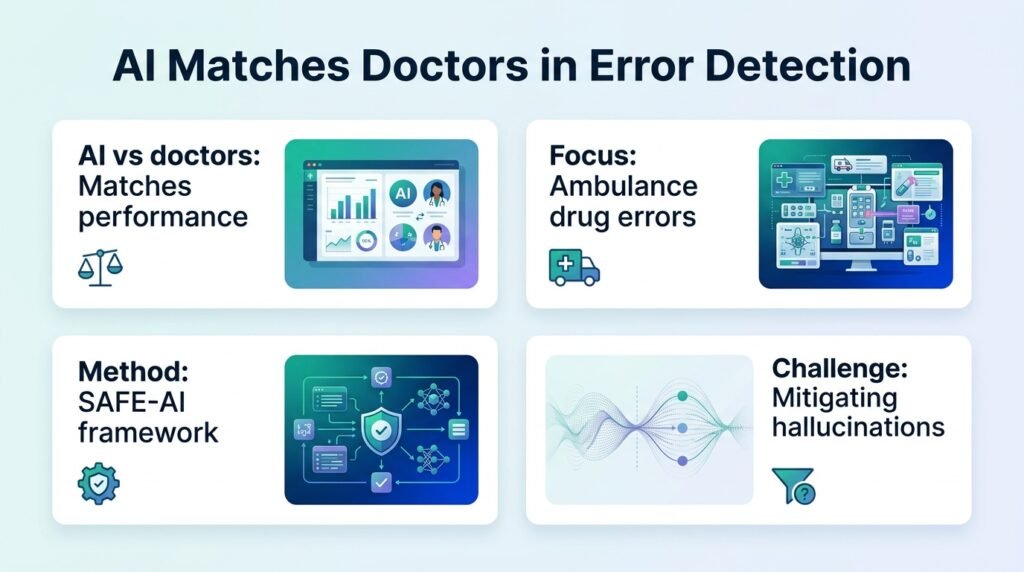
A new rule-bound AI framework matches human physicians at finding dangerous epinephrine errors in emergency medical charts.
Can we trust a hallucination-prone chatbot to audit life-or-death medical mistakes? Standard language models fail in high-stakes clinical audits because they guess the next word instead of following medical logic. This study challenges the assumption that we must accept AI hallucinations as an inevitable cost of automation.
By forcing the AI into an ontology-driven straitjacket, researchers proved that deterministic rules, not bigger datasets, are the key to clinical safety. This shifts how we should judge clinical AI. We do not need smarter models; we need tighter constraints.
How the AI performed
Researchers built SAFE-AI and tested it on 18,402 lines of clinical data from 300 emergency medical services (EMS) charts. Two expert physicians independently reviewed the same charts to establish a baseline, achieving a 96% inter-rater agreement on epinephrine adverse safety events. The AI was then evaluated against these expert labels.
- Achieved 97.9% accuracy in detecting epinephrine overdoses.
- Reached 91.6% accuracy in identifying delays in epinephrine administration.
- Significantly outperformed standard baseline language models.
These numbers show that structured AI can match human experts in high-stakes, low-probability scenarios. Interestingly, when the AI and doctors disagreed, it was often due to justifiable differences in clinical judgment rather than AI errors. This suggests the tool functions as a legitimate clinical peer rather than a simple keyword filter.
The end of probabilistic guessing
Most medical AI tools rely on probabilistic pattern recognition, which inherits biases from training data. This study proves that anchoring a model to a strict, rule-based medical ontology eliminates the dangerous “creative writing” of standard models. This aligns with research in npj Digital Medicine on measuring clinical safety and hallucination rates.
While other researchers have shown that adapted models can write clinical summaries well, as discussed in Nature Medicine, auditing safety events requires a much higher level of logical precision. SAFE-AI shows how to achieve that precision without building a massive, expensive custom model.
The limits of the rules
The system is not perfect. It still relies on structured rules, meaning it is only as good as the medical ontology humans program into it. If a clinical scenario falls outside these pre-defined rules, the system’s performance could degrade.
However, this approach shifts the paradigm. Instead of waiting for language models to magically stop hallucinating, we can build guardrails that force them to behave.
This analysis is based on research published in PLOS Digital Health.