

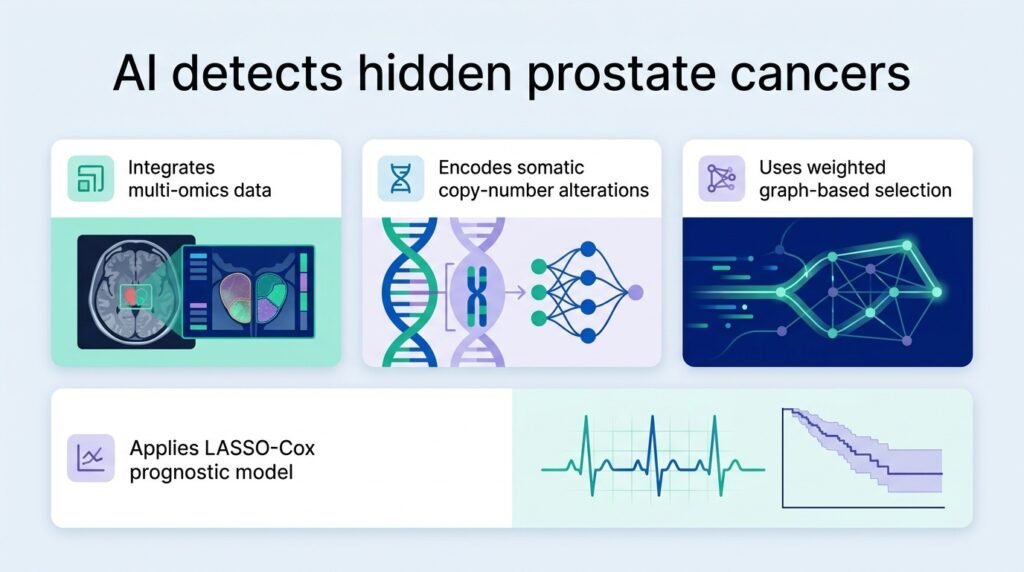
Standard clinical guidelines are letting aggressive prostate cancers slip through the cracks, but a new multi-omics AI model exposes these hidden threats before they spread.
How do you tell a patient their low-risk cancer is actually a ticking clock? Doctors rely on standard tissue grades to recommend active surveillance for early-stage prostate cancer, assuming these tumors will remain dormant. But biology is rarely that neat. Many patients classified as low-risk harbor silent, aggressive mutations that slip past traditional pathology. This disconnect is where standard diagnostics fail.
A new study challenges the safety of active surveillance by proving that some low-risk tumors are already undergoing a rapid molecular transition. By looking beyond simple tissue structures, researchers built a machine learning framework that maps the complex, multi-layered biology of the tumor. This shifts the paradigm from watching and waiting to active molecular profiling. It means we must rethink what low-risk actually means. This builds on previous efforts to map tumor behavior, such as using a DNA replication stress model to predict clinical outcomes.
The hidden master regulator
The researchers trained their model on the TCGA-PRAD dataset of 498 patients. They integrated somatic copy-number alterations, epigenomics, and transcriptomics into a patient-specific biological network. This multi-layered analysis revealed details that single-gene tests miss.
The model identified a single master regulator gene called ZNF268. When the promoter region of this gene is hypermethylated, it triggers an oncogenic transition found exclusively in low-to-intermediate-risk patients. The loss of this gene’s normal function rewires the tumor’s co-expression network. The study quantified this disruption as a Rewiring Score. Patients with high rewiring scores faced a hazard ratio of 2.79 for progression-free survival (95% CI: 1.36–5.71, p = 0.0049). This metric also successfully predicted biochemical recurrence in two external validation cohorts.
New targets for therapy
This finding does more than just flag danger. It points to specific solutions. Low-ZNF268 tumors showed predicted sensitivity to MAPK, ATR, and PI3K/mTOR inhibitors. This means patients who would normally just be watched can instead be matched to targeted therapies early. This targeted approach aligns with other recent work using machine learning to identify epithelial cell marker genes to improve prostate cancer outcomes.
- Analyzed multi-omics data from 498 patients in the TCGA-PRAD cohort.
- Identified ZNF268 hypermethylation as the key driver of early aggressive disease.
- Calculated a Rewiring Score linked to a 2.79-fold increase in progression risk.
- Revealed tumor sensitivity to MAPK, ATR, and PI3K/mTOR inhibitors.
The limits of prediction
While the biological insights are deep, clinical translation is not immediate. Multi-omics sequencing is expensive and complex compared to standard biopsies. The model must prove it can be run cost-effectively in standard hospital labs before it can safely replace current surveillance protocols.
Read the full study in npj Digital Medicine.