
A popular metric used to grade medical AI scribes fails to flag the rare errors that actually endanger patients.
How do you know if an AI medical scribe is safe? For years, the industry has relied on Word Error Rate (WER) to judge transcription quality. If a tool gets most of the words right, we assume it is safe for the clinic. But this assumption is dead wrong. It treats a misplaced comma the same as a mangled drug dosage.
This disconnect challenges how health systems buy and vet clinical AI. By focusing on aggregate accuracy, developers are optimizing for the wrong target. We are polishing spelling while missing the rare, catastrophic errors that can harm patients.
The Typos That Do Not Matter
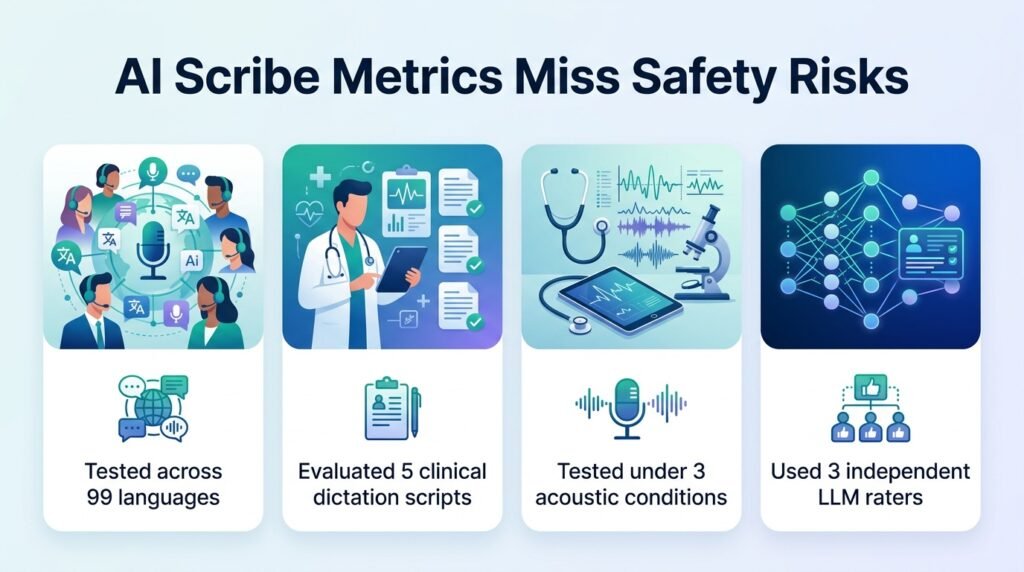
A new study exposed this gap by testing a production ambient scribe. Researchers used five clinical dictation scripts translated into 99 languages under three acoustic conditions. Out of 59,819 genuine transcription-error occurrences, the vast majority—58,329 (97.5%)—were low risk. Only 251 (0.42%) were classified as critical or high risk.
None of the six standard frequency metrics showed a meaningful link to serious clinical risk. The correlation strengths fell below a weak Spearman’s rho of 0.16. Instead, aggregate error metrics were heavily dominated by benign typos, showing a strong correlation of 0.80 with the overall severity-likelihood sum. The metrics measure noise, not danger.
The Resource Bias Illusion
This metric mismatch creates a false sense of alarm for certain languages. At complexity level three, low-resource languages showed significantly worse WER than high-resource languages, with a beta of +0.078 (95% CI +0.045 to +0.111). Yet, there was no detectable difference in actual critical or high-risk errors between these language groups, yielding an odds ratio of 1.21 (95% CI 0.43 to 3.43).
Instead of language resources, the true driver of danger was clinical complexity. Each jump in consultation complexity tripled the odds of a serious error, carrying an odds ratio of 3.06 per level. Complex cases breed dangerous mistakes, regardless of the language spoken.
Rethinking AI Safety Metrics
Health systems must stop using WER as a proxy for clinical safety. A high error rate might just mean an AI struggled with an accent, not that it prescribed the wrong medication. To solve this, teams are looking at alternative validation methods. For instance, researchers are exploring cross-model disagreement to flag high-risk transcription errors before they reach the patient chart.
Admittedly, this study relied on synthetic speech and large language models to rate clinical risk, which may not perfectly capture real-world clinical environments. However, the core lesson stands. If we do not measure clinical risk directly, we are just counting typos while missing the medical crises.
Key Findings
- Only 0.42% of the 59,819 analyzed errors posed critical or high clinical risks.
- Standard transcription metrics showed almost zero correlation (Spearman’s rho <0.16) with serious clinical risk.
- Consultation complexity was the main driver of danger, increasing serious risk by an odds ratio of 3.06 per level.
Read the full study in medRxiv.