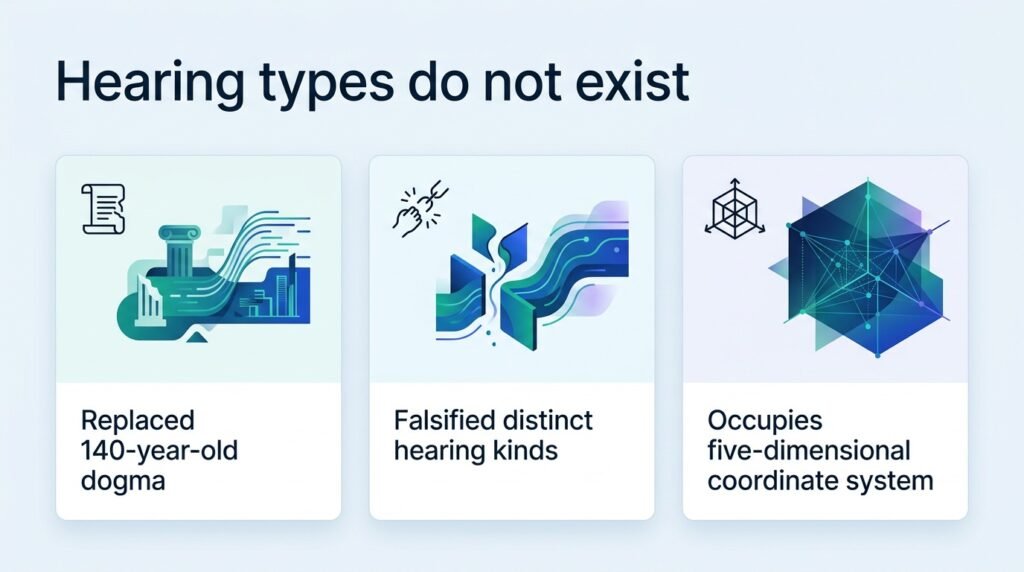
A massive new analysis of four million audiograms blows up a century of clinical dogma by proving that distinct categories of hearing loss are merely mathematical illusions.
For 140 years, ear doctors sorted patients into neat boxes. Your hearing loss was either mild, severe, or fit a specific shape. This classification dictated treatment, clinical trials, and insurance payouts.
It turns out those boxes do not exist. By reducing complex hearing data to simple averages, medicine has spent decades chasing ghosts. This challenges the entire foundation of otology. It also complicates the development of digital health tools, which have been trained on these rigid, artificial categories.
Ditching the neat boxes
Researchers built the Human Hearing Atlas to test the old classification system. They analyzed more than 4.29 million audiograms spanning 33 datasets, eight countries, and 62 years of clinical data. The records crossed two different calibration standards, making this one of the largest hearing studies ever conducted.
Instead of finding distinct “types” of hearing, the data revealed a continuous, five-dimensional coordinate system. The classic categories reported since 1932 are actually statistical artifacts. They were caused by rounding data to 5 dB intervals and pooling different patient groups together. Hearing is a spectrum, not a checklist.
What we missed
This is not just an academic correction. It means current diagnostic tools are functionally blind to real changes in patient health. If clinical trials for hearing recovery drugs rely on these old categories, they are likely missing subtle signs of progress or decline.
The new atlas changes how we track ear health by offering a highly precise alternative. Key findings from the study include:
- It reconstructs unseen audiograms to near-decibel accuracy while preserving clinical details.
- It maps hearing changes over hours or decades, revealing that half of these shifts are invisible to conventional severity averages.
- It establishes the Law of Human Hearing States, defined by four empirical invariants.
The path to precision
AI diagnostic tools trained on old, categorical labels are inherently flawed because they learn to replicate human errors. The atlas replaces arbitrary categories with precise, universal trajectories. This shifts otology from crude labeling to true precision medicine, which is vital for genetics and regenerative therapies.
Transitioning clinics away from the simple 5 dB audiogram grid to a five-dimensional coordinate system will face massive bureaucratic friction. Insurance companies and regulators rely on simple categories to approve treatments. But the data is clear. The old way of measuring hearing is broken, and continuing to use it means ignoring half of what is happening to a patient’s ears.
Read the full study in medRxiv.