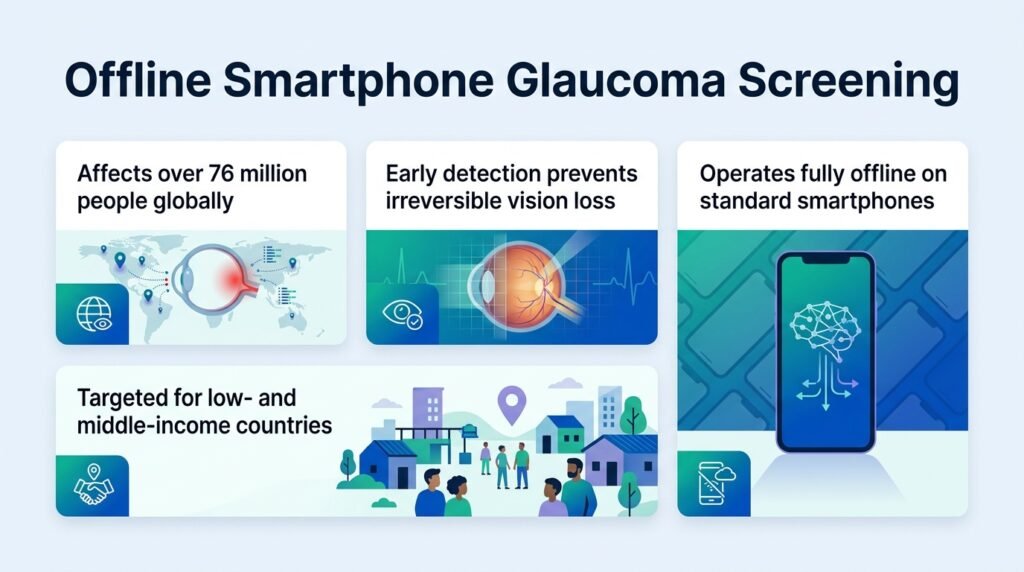
A new offline AI diagnostic tool achieves perfect sensitivity in cross-site testing, proving that high-end clinical hardware is no longer the only way to prevent blindness.
Why do we assume cutting-edge medical AI requires a constant cloud connection and a $20,000 fundus camera? In the regions where glaucoma strikes hardest, both internet and expensive hardware are non-existent. This digital divide usually dooms local screening efforts before they even start.
This trial challenges the assumption that diagnostic AI must live in the cloud to be accurate. By running entirely locally on a standard smartphone, the system shifts the bottleneck of eye care from infrastructure to simple distribution.
The hardware shift
The researchers built a platform called Glaucoma Screening on Phone (GSoP). It pairs a standard smartphone with a cheap 3D-printed optical adaptor. Using this setup, non-specialists captured 345 short optic disc videos from 208 adults across two clinical sites.
The on-device software does not need the internet. It uses a YOLOv8n module to locate the optic disc, which it did with 100% accuracy. Then, an EfficientNetV2-B0 model classifies the image. The entire process takes just 2 to 3 minutes per eye. This speed and local processing match trends highlighted in Smartphone Eye Examination: Artificial Intelligence and Telemedicine, which notes how mobile tools are moving diagnostics out of traditional clinics.
The domain shift test
Most AI models fail when tested on a new patient population. This study put that vulnerability to the test by moving the model from its primary site (JUMC) to an independent site (UZ Leuven).
The results show a vital trade-off in performance:
- The model achieved 100% accuracy, sensitivity, and specificity on the primary-site holdout dataset.
- On the cross-site dataset, accuracy dropped to 76.9% and specificity fell to 71.9%.
- Crucially, sensitivity remained at 100% during this cross-site test.
For a screening tool, keeping sensitivity at 100% is what actually matters. It means the AI did not miss a single case of glaucoma, even when the image quality and patient demographics changed. The drop in specificity just means more healthy patients were flagged for follow-up, which is an acceptable compromise for a first-line defense.
The real-world catch
We must be honest about the hurdles. The study used pharmacological dilation, meaning patients needed eye drops to widen their pupils before screening. This requirement prevents true autonomous use by untrained community workers. As discussed in Innovations in Glaucoma, the next step for mobile screening is mastering non-mydriatic imaging, where eyes are imaged without drops.
Furthermore, this was a case-control study, not a random community screening. The AI was tested on known cases and healthy controls, which artificially inflates performance compared to real-world clinics.
Even with these limits, the GSoP platform proves that offline clinical AI is viable. It shows we can build highly sensitive diagnostic tools that do not rely on expensive infrastructure or stable web connections.
This analysis is based on research published in BMC Medical Informatics and Decision Making.