The field of endocrinology is undergoing a profound shift as artificial intelligence transitions from an academic novelty into an operational clinical layer. No longer confined to basic retrospective analysis, AI is actively bridging the gap between metabolic control and systemic health. This month’s developments highlight a double-sided evolution: the expansion of predictive models that can identify metabolic risk up to a decade before clinical onset, and the rapid, real-world integration of automated, closed-loop delivery systems that handle the daily cognitive burden of diabetes management.
For clinicians, digital health investors, and product teams, the implications are clear. We are moving away from isolated glucose tracking toward integrated, multi-system modeling. Whether it is linking metabolic pathways to cognitive decline, using retinal scans to predict gestational diabetes, or automating insulin delivery via multi-device partnerships, AI is establishing itself as the core infrastructure of modern endocrinology.
Notable papers
• Multimodal MRI-to-PET image translation recovers disease-specific hypometabolism in epilepsy and mild cognitive impairment
This study demonstrated that generative AI can translate non-radioactive MRIs to estimate PET-level glucose hypometabolism, recovering disease-specific metabolic deficits with high fidelity.
Brand take: Genuinely useful clinically, as it offers a pathway to track metabolic brain health without repeated radioactive tracer exposure.
• Glucagon-like peptide-1 receptor agonist initiation and risk of clinically recorded Alzheimer’s disease-type dementia in older adults with type 2 diabetes: a target trial emulation using causal machine learning
Using causal machine learning, researchers found that GLP-1 receptor agonist initiation significantly delays the onset of Alzheimer’s-type dementia in older adults with type 2 diabetes.
Brand take: Genuinely useful clinically, providing robust, computationally backed evidence for the neuroprotective benefits of metabolic therapies.
• Predicting Diabetes a Decade Before Diagnosis
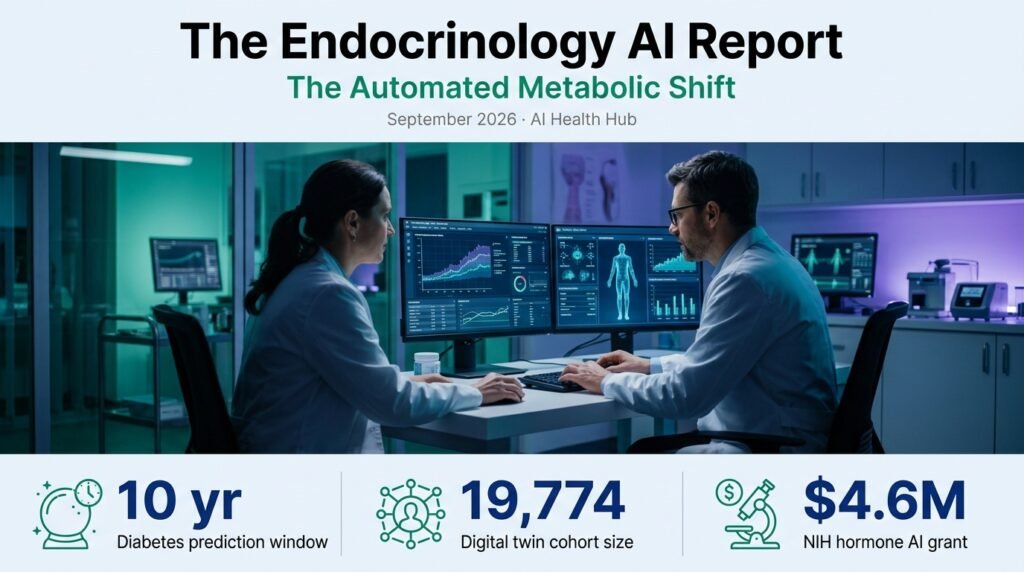
A machine learning model trained on data from over three million patients successfully predicted the risk of developing type 2 diabetes up to ten years before clinical diagnosis.
Brand take: Underrated, because while the predictive power is immense, the clinical bottleneck remains our systemic inability to manage millions of newly flagged prediabetic patients.
• AI Links Loneliness to Type Two Diabetes
A digital twin model analyzing 19,774 UK adults demonstrated that social isolation and mental health metrics are direct, quantifiable drivers of metabolic dysfunction and type 2 diabetes risk.
Brand take: Genuinely useful clinically, as it forces endocrinologists to treat psychosocial factors as direct physiological variables rather than secondary lifestyle issues.
• Eye scans help predict pregnancy diabetes risk
Integrating deep learning retinal imaging with standard maternal blood tests improved early gestational diabetes screening accuracy before the traditional 24-week glucose tolerance test.
Brand take: Overhyped, because the incremental diagnostic gain over existing clinical risk models is still too small to justify immediate, widespread retinal scanning in standard obstetric workflows.
• Bibliometric and Latent Dirichlet Allocation (LDA) analysis of artificial intelligence for thyroid nodules
This systematic analysis mapped the rapid integration of deep learning models in ultrasound-based thyroid nodule malignant risk stratification, showing high diagnostic consistency.
Brand take: Genuinely useful clinically, as it standardizes highly variable ultrasound interpretations and reduces unnecessary fine-needle aspiration biopsies.
Products, deals & funding
• Senseonics & Beta Bionics Integration: Senseonics partnered with Beta Bionics to integrate its Eversense 365 continuous glucose monitor (CGM) with the iLet Bionic Pancreas automated insulin delivery system. This brings a long-term, implantable sensor option to automated, algorithmic insulin delivery.
Brand take: Genuinely useful clinically, as a 365-day sensor drastically reduces the physical and cognitive burden of frequent sensor changes for patients on closed-loop systems.
• NIH Hormone AI Grant: The NIH awarded a multi-university team $4.6 million to digitize 40 years of hormone research using AI, with the goal of creating foundational models to personalize treatments for diabetes and obesity.
Brand take: Underrated, as building clean, historical datasets is the unglamorous but essential groundwork required to train the next generation of endocrine foundation models.
• Revvity Acquisition of Human Cell Design: Revvity agreed to acquire Human Cell Design to leverage human-relevant cell models and AI-driven screening for metabolic disease drug discovery, specifically targeting beta-cell function.
Brand take: Genuinely useful clinically, as translating early-stage drug discovery to human-relevant models sooner will accelerate the pipeline for novel insulin-sensitizing therapeutics.
Regulatory & clinical adoption
• FDA TEMPO Pilot Program: Dexcom joined the FDA’s new TEMPO pilot program to evaluate its AI-driven Glucose Health Program, designed to streamline prediabetes and Type 2 diabetes screening in primary care settings.
Brand take: Genuinely useful clinically, as moving CGM data and predictive AI into the primary care screening workflow is the only way to scale early metabolic intervention.
• Insulet Omnipod 5 Software Update: Insulet rolled out a major software update for the Omnipod 5 automated insulin delivery system in the US and Europe, introducing direct integration with the Dexcom G7 and FreeStyle Libre 3 Plus, alongside a lower target glucose setting.
Brand take: Genuinely useful clinically, as expanding sensor compatibility and lowering target thresholds allows clinicians to safely tighten glycemic control for highly variable patients.
Trends & what to watch
The dominant trend in endocrinology AI is the rapid convergence of hardware interoperability and predictive analytics. For years, patients and clinicians were trapped in single-vendor ecosystems. The recent integrations of Senseonics, Beta Bionics, Insulet, and Abbott demonstrate that the industry is finally accepting an open-architecture reality. The value is shifting from the physical hardware (pumps and sensors) to the proprietary control algorithms that drive automated insulin delivery.
Over the next 1-3 months, watch for the clinical rollout of the FDA’s TEMPO pilot program. If successful, this will mark a transition where CGMs are no longer viewed merely as therapeutic tools for insulin-dependent patients, but as diagnostic and preventive screening tools for the broader prediabetic population. Additionally, clinical product teams should monitor the development of multimodal foundation models in endocrinology, which are beginning to combine continuous glucose data, electronic health records, and even social determinants of health to predict long-term microvascular complications.
Bottom line
Endocrinology is transitioning from manual, reactive glucose tracking to an era of automated, algorithm-driven metabolic care that spans from early prevention to closed-loop delivery.