
A new AI model automates the tedious task of reading brainwaves to track whether ICU patients are drifting back to consciousness.
How do you know if a comatose patient is still in there? Right now, doctors rely on manual, expert-level visual inspections of EEG power spectra to spot signs of recovery. It is a slow, subjective process that is highly prone to human error in a busy ICU.
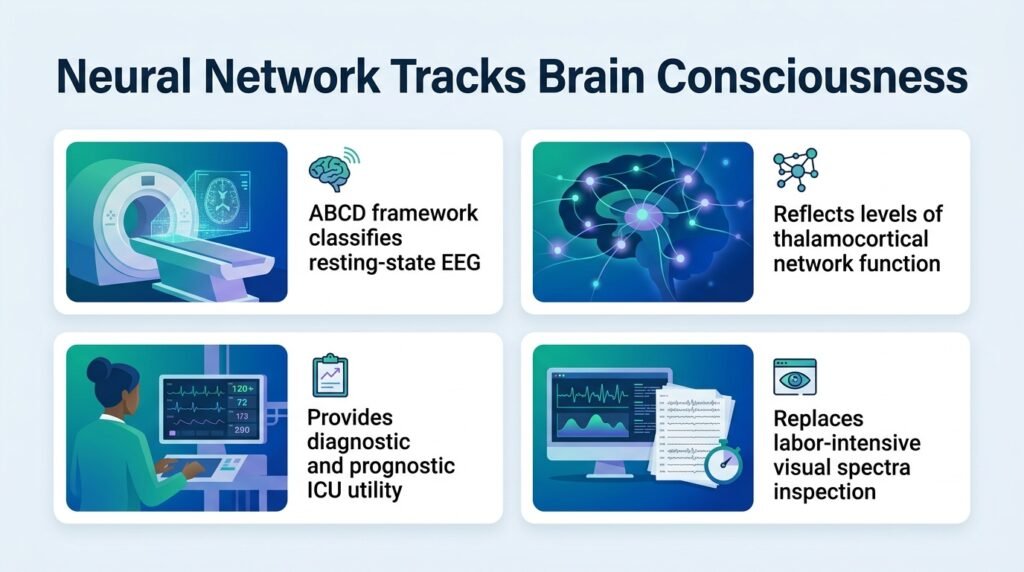
This new research changes the stakes. By automating the “ABCD” framework of brainwave classification, researchers are shifting consciousness tracking from a rare, specialist-dependent event to a continuous bedside metric. This challenges the assumption that complex neurological states require human eyes to interpret.
This is not about replacing doctors. It is about catching the fleeting moments of awareness that humans miss. If an algorithm can monitor thalamocortical network function around the clock, clinicians can tailor therapies to the exact moments a patient’s brain is most receptive. This builds on previous efforts to find reliable markers, such as Multimodal Biomarkers of Consciousness in Acute Severe Traumatic Brain Injury, which highlighted the urgent need for objective bedside tools.
How the AI performed
Researchers trained a convolutional neural network using 4,611 manually classified EEG power spectra. The AI learned to categorize these scans into the ABCD framework, which maps resting-state clinical EEG to thalamocortical network function. The resulting classifier matched the accuracy of human experts and outperformed alternative automated spectral analysis methods.
To prove it works in the real world, the team tested the model on continuous EEG data from a patient with acute severe traumatic brain injury. The AI successfully mapped state fluctuations with high temporal and spatial resolution. This continuous tracking is vital because consciousness in acute brain injury is rarely a simple “on” or “off” switch.
- Trained on 4,611 manually classified EEG power spectra.
- Matched the gold standard of expert visual inspection.
- Outperformed existing automated spectral analysis tools.
- Successfully tracked continuous fluctuations in an ICU patient.
The hurdles ahead
The main limitation is that this is still a proof-of-concept. The continuous tracking was demonstrated on a single ICU patient with traumatic brain injury. Before this can be deployed widely, it needs validation across larger, more diverse patient cohorts.
Furthermore, while clinical EEG is widely available, integrating real-time AI pipelines into legacy ICU hardware remains a massive operational bottleneck. As discussed in Conventional and Investigational Approaches Leveraging Clinical EEG for Prognosis in Acute Disorders of Consciousness, translating these tools to the bedside requires overcoming significant technical hurdles.
Ultimately, this tool could turn EEG from a static snapshot into a dynamic movie of recovery.
Read the full preprint in medRxiv.