
AI reads doctor notes to predict early frailty
By analyzing the hidden text in medical records, a new AI tool spots life-threatening frailty decades before patients reach old age.
Why do we treat physical decline like an issue that suddenly appears at retirement? For decades, medicine has viewed frailty as a problem exclusive to geriatrics. This binary thinking means we miss the slow, quiet onset of decline during middle age when intervention is actually most effective.
A new preprint challenges this status quo by proving that deep learning can map biological decline in adults as young as 35. By parsing the unstructured text of clinical notes, this model shifts frailty from a late-stage diagnosis to a continuous, preventable metric. It forces us to rethink how we track aging.
Reading between the lines
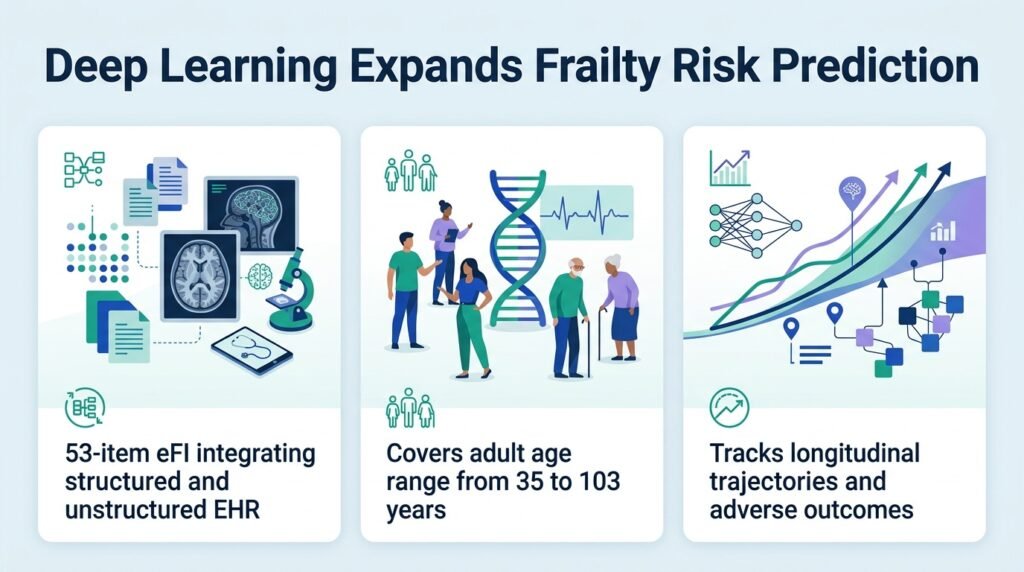
Researchers in Finland analyzed longitudinal health records from 193,629 individuals aged 35 to 103 between 2010 and 2023. They built a 53-item electronic frailty index (eFI) by combining standard lab tests and billing codes with unstructured clinical notes processed by deep learning. This approach captures the qualitative observations doctors type out but rarely translate into formal billing codes.
The resulting AI model outperformed traditional clinical tools like the Hospital Frailty Risk Score and the Charlson Comorbidity Index. It proved that the most valuable predictive data is often trapped in free-form text. By analyzing these narrative notes, the model detected early-stage vulnerability that traditional structured databases completely ignored.
The cost of waiting
The data shows that waiting until senior citizenship to measure frailty is a major clinical mistake. While frailty trajectories accelerated sharply after age 65, the risk signatures were highly predictive in much younger cohorts. Severe frailty, as flagged by the AI, correlated with dramatic spikes in adverse health events across the entire population.
According to the study, individuals flagged with severe frailty faced:
- A 7.31-fold increase in all-cause mortality risk.
- A 9.22-fold higher risk of suffering severe infections.
- A 2.75-fold increase in bone fractures.
- A 3.15-fold increase in overall healthcare utilization.
These are not minor statistical deviations. They represent a massive burden on health systems that could be mitigated if caught early. The risk patterns persisted even when the researchers restricted their analysis to individuals traditionally classified as non-frail.
Rethinking preventative care
The real value of this tool is its sensitivity at the low end of the spectrum. By identifying subtle decline in younger adults, the algorithm allows clinicians to intervene before irreversible damage occurs. It turns frailty into a modifiable risk factor rather than an inevitable destination.
However, implementation faces hurdles. Free-text clinical notes are notoriously messy, and local writing styles vary across hospitals. Scaling this deep-learning tool will require strict data standardization that many legacy health systems are not yet equipped to handle. There is also the risk of algorithmic bias if the training text reflects systemic disparities in how doctors document patient care.
Even with these limitations, the study proves that frailty is a spectrum, not a late-life cliff. It is time to stop treating aging as a surprise that begins at age 65.
Read the full preprint in medRxiv.