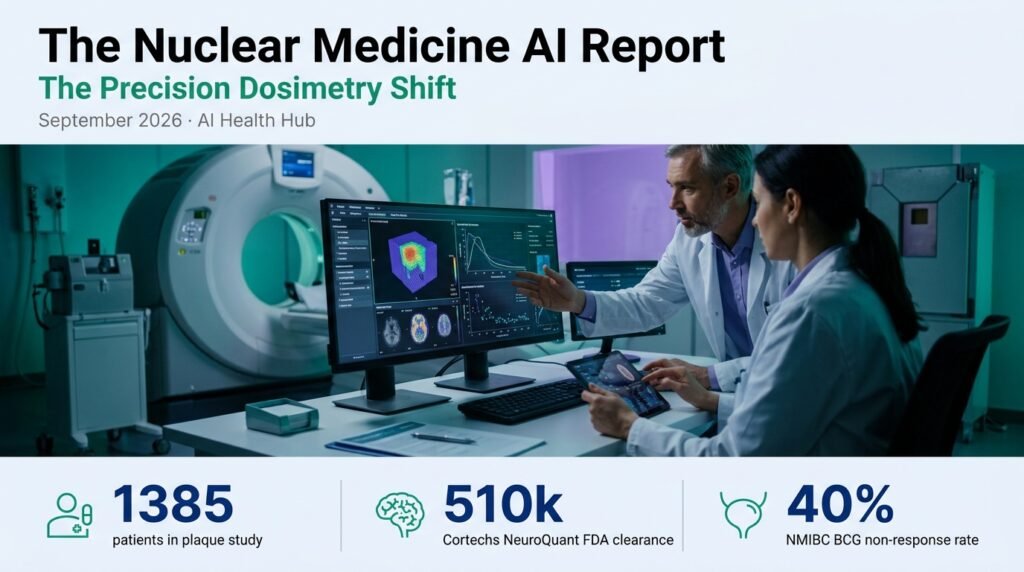
Nuclear medicine is undergoing a structural transition. The historical paradigm of qualitative, visual scan interpretation is being replaced by quantitative, AI-driven pipelines that integrate molecular imaging with personalized therapeutic dosimetry. Driven by the clinical expansion of radiotheranostics and the regulatory clearance of automated quantification tools, clinical teams are moving away from empirical, weight-based dosing toward precise, patient-specific lesion targeting.
This shift is particularly critical as novel diagnostic tracers and therapeutic pairs enter the clinic. Without automated segmentation and quantitative analysis, the cognitive and computational burden of managing multi-timepoints dosimetry would overwhelm clinical workflows. The latest clinical evidence and regulatory clearances demonstrate that AI is no longer just an optional secondary reader, but the core infrastructure required to scale molecular radiotherapy.
Notable papers
• Future of radiotheranostics
This paper outlines how the clinical success of 177Lu-DOTATATE and 177Lu-PSMA-617 is accelerating the shift from empirical dosing to personalized, AI-assisted molecular dosimetry.
Brand take: Genuinely useful clinically, as it establishes the absolute necessity of automated computational tools to make patient-specific dosimetry practical for busy clinical departments.
• Time-dependent prognostic value of coronary plaque burden and hyperemic myocardial blood flow
A study of 1,385 patients with suspected coronary artery disease demonstrated that quantitative plaque burden and hyperemic myocardial blood flow provide distinct, time-dependent prognostic value for cardiovascular events.
Brand take: Genuinely useful clinically, proving that automated quantification of physiological and anatomical metrics outperforms traditional binary stenosis assessments.
• Artificial intelligence across oncologic theranostics: evidence for patient stratification, dosimetry, and adaptive radiopharmaceutical therapy
A structured review mapping machine learning models across radiopharmaceutical therapy found that while AI shows high performance in segmentation and dosimetry, prospective clinical validation remains highly limited.
Brand take: Underrated, because it highlights the critical translational gaps that developers must address before clinical teams can trust AI for automated dose calculations.
• Emerging frontiers and challenges of artificial intelligence in PSMA-PET imaging: pioneering a new chapter in prostate cancer care
This paper reviews deep learning frameworks for automated lesion detection and tumor burden quantification in PSMA-PET imaging.
Brand take: Genuinely useful clinically, as manual segmentation of widespread metastatic disease is too time-consuming for routine clinical practice.
• A responsible artificial intelligence framework for translational readiness of machine learning biomarker models in clinical decision support
This review establishes a structured framework for translating machine learning biomarker models from retrospective performance to real-world clinical decision support.
Brand take: Genuinely useful clinically, offering a much-needed blueprint for clinical AI product teams to navigate regulatory and integration hurdles.
• ROLE OF ARTIFICIAL INTELLIGENCE METHODS IN BCG RESPONSE PREDICTION IN NON-MUSCLE INVASIVE BLADDER CANCER
This study explores machine learning models to predict non-response to intravesical Bacillus Calmette-Guérin (BCG) immunotherapy, which occurs in up to 40% of patients.
Brand take: Overhyped, as the model relies on highly heterogeneous datasets without external validation, making immediate clinical utility low.
Products, deals & funding
• Cortechs.ai NeuroQuant PET FDA Clearance
Cortechs.ai received FDA 510(k) clearance for NeuroQuant PET, an AI-powered automated quantification platform designed for amyloid PET imaging in Alzheimer’s disease and other neurological conditions [Cortechs FDA Clearance].
Brand take: Genuinely useful clinically, as objective quantification of amyloid burden is essential for patient selection and monitoring under new disease-modifying therapies.
• Lantheus Tauklarify FDA Approval
Lantheus received FDA approval for Tauklarify, a novel tau PET imaging agent that complements amyloid PET and other diagnostic tools in evaluating Alzheimer’s disease [Lantheus FDA Approval].
Brand take: Genuinely useful clinically, providing the molecular specificity required to stage neurodegenerative disease progression accurately.
• Cortechs.ai European CE Mark Expansion
Cortechs.ai expanded its European CE Marking under the EU MDR for its AI-powered quantitative imaging platform, including NeuroQuant Version 5 and OnQ Prostate [Cortechs CE Mark].
Brand take: Genuinely useful clinically, demonstrating that quantitative AI tools are successfully navigating the stringent regulatory pathways of the EU MDR.
Regulatory & clinical adoption
The regulatory landscape is rapidly adapting to support quantitative molecular imaging. GE HealthCare achieved a CE Mark for Photonova Spectra, its advanced photon-counting CT system powered by Deep Silicon detector technology, enabling high-definition spectral and spatial imaging [GE HealthCare CE Mark]. This hardware evolution, combined with AI-enabled reconstruction, provides the spatial resolution needed to detect micro-metastases and improve PET/CT co-registration. Meanwhile, large language models are entering the reporting workflow. A comparative study published in JMIR AI demonstrated that ChatGPT-4o can serve as a valuable adjunct in nuclear medicine reporting by improving the decisiveness and completeness of trainee-generated impressions [ChatGPT-4o Study]. While LLMs improve reporting efficiency, clinicians must remain vigilant against hallucinated clinical details in complex molecular imaging reports.
Trends & what to watch
Over the next 1-3 months, the primary trend to watch is the clinical integration of multi-modal AI models that combine PET/CT imaging with genomic and clinical data. As highlighted in the literature, single-modality imaging is often insufficient for predicting long-term therapeutic response. Clinical AI product teams must focus on building pipelines that ingest both spatial imaging features and molecular biomarkers to guide patient selection for high-cost radiopharmaceutical therapies.
Furthermore, the industry is moving toward standardized, vendor-neutral quantitative platforms. The clearance of tools like Cortechs.ai’s NeuroQuant PET indicates that hospitals want unified software solutions that can process scans from different scanner manufacturers without recalibration. AI developers who fail to account for instrument-to-instrument variation will find their clinical adoption stalled, a challenge we have previously analyzed in mass spectrometry-based diagnostics [Yesil Science Superbugs].
Bottom line
The future of nuclear medicine belongs to automated, quantitative AI pipelines that turn complex molecular scans into precise, actionable therapeutic dosimetry.