Health systems are rushing to install generative AI assistants, but a new trial shows doctors are already tuning them out.
Why do doctors reject software that actually helps them? A randomized controlled trial of Epic’s generative AI chart summarization tool reveals a bizarre contradiction. The AI successfully reduced mental fatigue and burnout. Yet, clinicians hated using it, ignored most of its outputs, and abandoned it in droves over just ninety days.
This disconnect challenges the tech industry’s core assumption. We assume that if a tool reduces cognitive load, clinicians will naturally embrace it. Instead, this trial suggests that even helpful AI can fail if it creates friction or seeds distrust.
The data behind the disconnect
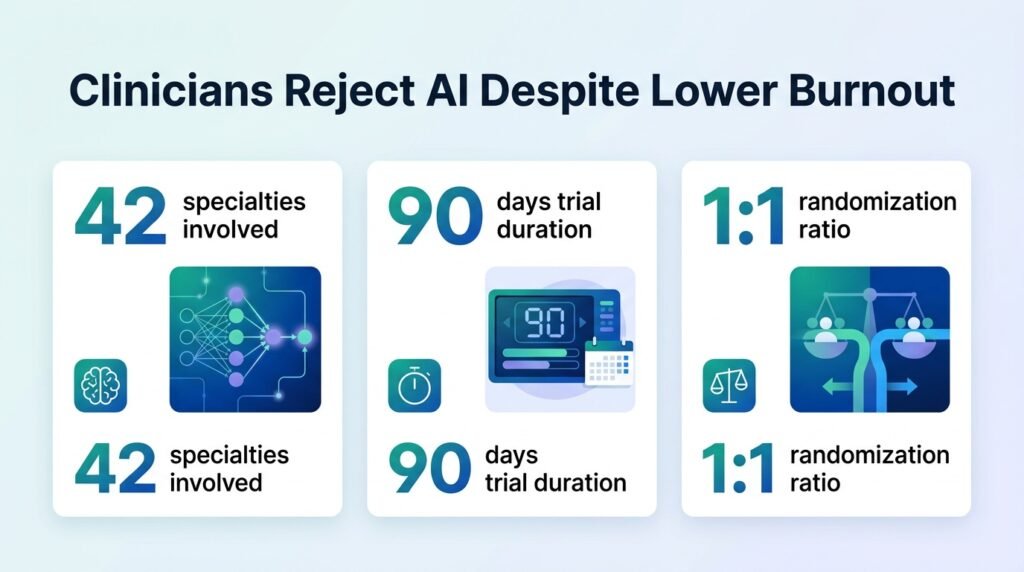
The pragmatic trial tracked 284 outpatient clinicians across 42 specialties for 90 days in early 2026. Researchers split the doctors into two groups: one using Epic’s built-in AI summarizer and one using standard care. While the system automatically generated 74,474 AI chart summaries, clinicians only interacted with 14.2% of them.
Worse, engagement plummeted over time. Monthly active usage dropped from 88.7% to 66.2%, and actual interactions with the summaries halved from 21.5% in the first month to just 10.5% by the third.
The clinical trial results paint a highly conflicted picture:
- The tool reduced physician task load by 27.4 points on a 400-point scale.
- Overall burnout scores fell by 0.20 points, and work exhaustion dropped by 0.24 points on a 4-point scale.
- It saved virtually no time, shaving off a mere 1.2 seconds per charting encounter.
- The tool scored a dismal Net Promoter Score of -22.
- More than half of the users (57.1%) flagged concerns about inaccurate information or tool limitations.
Why doctors walk away
Saving 1.2 seconds is not a victory. It is a rounding error. Clinicians are exhausted by administrative burdens, a crisis detailed in “Making Progress on Progress Notes”. If a tool does not actually speed up their day, they will not tolerate its flaws.
The real friction is trust. When 57.1% of clinicians report concerns about inaccurate data, they must double-check every summary. This constant vigilance creates a different kind of mental tax. As explored in “The Machine Will See You Now”, the clinical perspective on AI is often shaped by this fear of quiet errors. Doctors would rather read the raw chart themselves than risk acting on a polished but flawed AI hallucination.
The analyst’s take
Health systems must stop measuring AI success by deployment rates or simple burnout surveys. This trial proves that a tool can technically “work” on paper while failing in the clinic. If users actively abandon a tool that reduces their task load, the implementation is broken.
The future of clinical AI is not about generating more automated summaries. It is about building interfaces that clinicians can actually trust without secondary auditing. Until developers solve the accuracy and trust gap, these expensive integrations will remain expensive shelfware.
Source: medRxiv