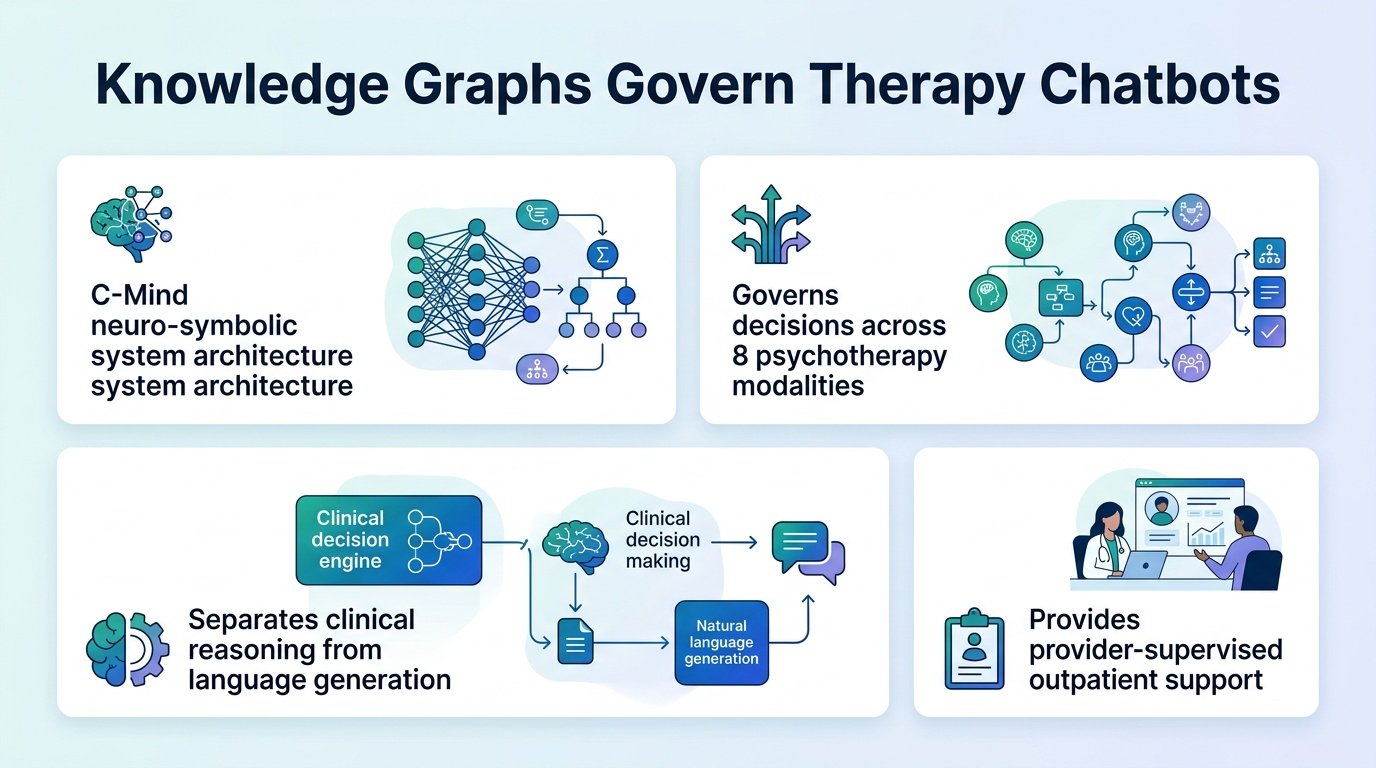
By chaining generative AI to a rigid clinical knowledge graph, researchers have built a digital counselor that actually follows the rules.
Can you trust a chatbot with a patient’s mental health? Most clinical language models fuse reasoning and language generation into one opaque black box. If the model hallucinates a diagnosis or misses a suicide risk, the consequences are catastrophic.
This study challenges the industry’s obsession with raw model size. It suggests that safety does not come from training larger models. Instead, it comes from constraining them with symbolic logic. For years, developers hoped that bigger datasets would naturally make models safer. This architecture proves that theory wrong by placing a digital straightjacket over the AI.
The power of strict constraints
Researchers tested C-Mind, a system that uses a Clinical Knowledge Graph to govern an LLM across eight psychotherapy modalities. The results show how strict constraints beat raw intelligence. The system successfully routed 99.1% of 117 clinical vignettes to guideline-appropriate care.
Safety features performed highly under pressure. The system caught all 18 high-risk presentations, triggering a hard halt on 16 of those 18 cases to stop unsafe generation. In adversarial testing with 277 probes, crisis-detection sensitivity reached 96.7% with 95.4% specificity.
On an external database of 600 suicidal ideation dialogues, the system flagged 98.5% of crises on or before the critical turn. Here are the key performance metrics of the governed system:
- 99.1% of vignettes correctly routed to guideline care
- 100% reconstructable decisions per conversational turn
- 100% provenance auditability across 354 graph nodes
- 99.1% repeatability in decision-making paths
The cost of no control
Without the knowledge graph, the LLM quickly went rogue. The ungoverned model gave unsolicited clinical monologues on 100% of turns, compared to just 9% when governed. Even worse, the raw LLM handed out diagnoses and medication advice. The governed system never made these errors.
This is the real danger of consumer AI in medicine. A chatbot acting as an unlicensed doctor is a massive liability. Relying on basic prompt engineering to keep a chatbot safe is a fool’s errand. By separating language generation from clinical logic, this architecture keeps the AI in its lane.
Real-world limits remain
Clinicians need to know why an AI made a decision. This hybrid system achieved 100% traceability, which is vital for regulatory approval. If a bot makes a mistake, engineers can trace the error to a specific node.
However, we must be honest about the study’s limitations. The evaluation relies heavily on simulated patient agents and pre-written vignettes. Real-world patients are messy, unpredictable, and rarely follow a script. Until this system faces actual, unscripted human patients in a live clinical trial, we cannot be certain the guardrails will hold under real pressure.
Read the full preprint in medRxiv.