
The psychiatry AI landscape is undergoing a structural correction. For years, the market has been flooded with consumer-facing wellness chatbots and unvalidated digital therapeutics. This month, that paradigm faced a dual-front challenge: state legislatures are stepping in to ban unsupervised AI psychotherapy, while neuroAI companies are raising massive capital to build deep, clinically validated diagnostic foundation models. The message is clear: the future of psychiatry AI belongs to tools that augment, rather than attempt to replace, the clinical relationship.
This shift is driven by a growing recognition of the limitations of consumer-grade AI. As research shows, simply feeding raw wearable data into language models without specialized training fails to yield reliable clinical insights. Instead, the field is moving toward sophisticated predictive analytics and multimodal models that can identify objective biomarkers of mental illness. Clinicians and investors must prepare for a highly regulated, clinically rigorous environment where safety and validation are paramount.
Notable papers
• Facts label for transparent communication of AI Risks in mental health technology
This paper proposes a standardized ‘facts label’ framework to help mental health clinicians evaluate the utility, safety, and risks of AI-enabled digital mental health technologies (AI-DMHTs).
Brand take: Genuinely useful clinically, as it provides a practical framework for clinicians to evaluate AI tools before introducing them to vulnerable patients.
• Smart rings and LLMs predict depression symptoms
This study demonstrates that feeding raw consumer smart ring data into a zero-shot language model fails to predict depression symptoms, highlighting the necessity of specialized clinical training and structured reasoning for LLMs.
Brand take: Genuinely useful clinically, as it exposes the dangers of using out-of-the-box LLMs for psychiatric diagnostics without domain-specific engineering.
• AI detects early depression for better treatment results
This research identifies a reversible ‘pre-disease’ window for depression using AI, demonstrating that treatment timing is more critical to therapeutic success than the specific intervention used.
Brand take: Underrated, as shifting the clinical focus from reactive treatment to early, proactive intervention could dramatically improve patient outcomes.
• Artificial Intelligence Connectedness: Theoretical Reconstruction of Connectedness and Its Impacts on Adolescent Mental Health
This study integrates the ethics of care and neo-ecological theory to reconstruct how generative AI interaction reshapes adolescent social ecosystems and emotional experiences.
Brand take: Overhyped, as theoretical reconstructions of AI connectedness lack the empirical clinical data needed to guide active psychiatric practice.
• Feasibility study on a noninvasive assessment of ALS patient emotional state
Using non-invasive speech analysis and data science on a cohort of 28 ALS patient visits, this study demonstrates that AI can objectively assess real-time emotional responsiveness and coping strategies.
Brand take: Genuinely useful clinically, as objective, non-verbal emotional assessment tools are desperately needed for patients with severe motor limitations.
• Advanced AI-Driven Predictive Analytics for Efficient Student Management in Higher Vocational Colleges
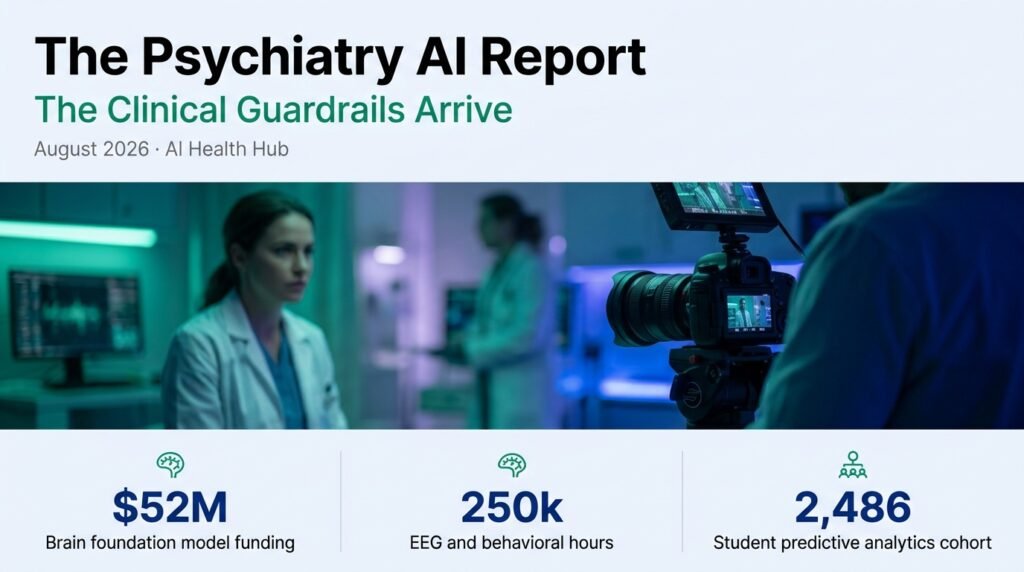
This study utilized empirical behavioral, psychological, and academic data from 2,486 enrolled students to build a predictive analytics model for early psychological risk detection.
Brand take: Underrated, as leveraging existing institutional digital touchpoints for passive mental health screening can catch at-risk youth before clinical crises occur.
Products, deals & funding
• Hemispheric Emerges from Stealth with $52M
NeuroAI company Hemispheric emerged from stealth with $52 million in total funding to build ‘Descartes,’ a brain foundation model trained on over 250,000 hours of EEG and behavioral data for neurological and psychiatric diagnosis.
Brand take: Genuinely useful clinically, as moving from subjective symptom checklists to objective, EEG-trained foundation models represents the true future of psychiatric diagnostics.
• Flourish Health Raises $46M
Flourish Health, a provider of intensive mental health care for high-acuity youth, raised $46 million (including a $26 million Series A led by B Capital, F-Prime, and Cherryrock Capital) to scale its psychiatrist-led care model using an AI-enabled workflow platform.
Brand take: Genuinely useful clinically, because it uses AI to optimize administrative and clinical workflows for human psychiatrists rather than attempting to replace them.
• OpenAI and APA Plan Youth Mental Health Guidance
OpenAI and the American Psychological Association (APA) announced plans to develop joint guidance on safe AI use for youth mental health, addressing the rapid rise of teen AI chatbot usage.
Brand take: Overhyped, as voluntary guidelines do little to mitigate the systemic risks of unregulated consumer chatbots interacting with vulnerable adolescents.
Regulatory & clinical adoption
• Colorado HB26-1195 Enacted
A new state law took effect in Colorado, prohibiting mental healthcare providers from using AI systems to direct or guide psychotherapy, or to interact with clients without synchronous, real-time human therapist oversight.
Brand take: Genuinely useful clinically, as it establishes a vital legal precedent that psychotherapy is an exclusively human, relational intervention.
• Stanford HAI Convenes Mental Health and AI Policy Workshop
Following its inaugural AI for Mental Health Symposium, the Stanford Institute for Human-Centered AI (HAI) published a policy workshop summary identifying key challenges in defining and regulating ‘mental health AI.’
Brand take: Underrated, as establishing clear regulatory definitions is the bottleneck preventing safe, reimbursable clinical AI tools from reaching the market.
Trends & what to watch
The regulatory landscape is hardening. Colorado’s HB26-1195 is not an isolated event; it represents the beginning of a legislative wave aimed at protecting the therapeutic alliance from automated replacement. Over the next 1-3 months, clinical product teams must pivot away from ‘autonomous therapist’ features and focus entirely on clinical decision support, administrative workflow automation, and objective diagnostic aids. Platforms that attempt to deliver unsupervised therapy will face severe legal and compliance hurdles.
Meanwhile, the funding environment is heavily favoring deep-tech neuroAI. Hemispheric’s $52 million raise highlights a growing investor appetite for objective, biological markers in psychiatry. Instead of relying on subjective patient self-reports, the next generation of psychiatric AI will leverage multimodal data—including EEG, speech patterns, and passive wearable telemetry—to identify psychiatric conditions before they manifest as full clinical crises. Clinicians should prepare for a future where AI acts as a highly sensitive diagnostic assistant, helping to pinpoint the optimal therapeutic window.
Bottom line
Psychiatry AI is transitioning from unregulated consumer chatbots to highly regulated, clinician-led diagnostic tools backed by hard neurobiological data.