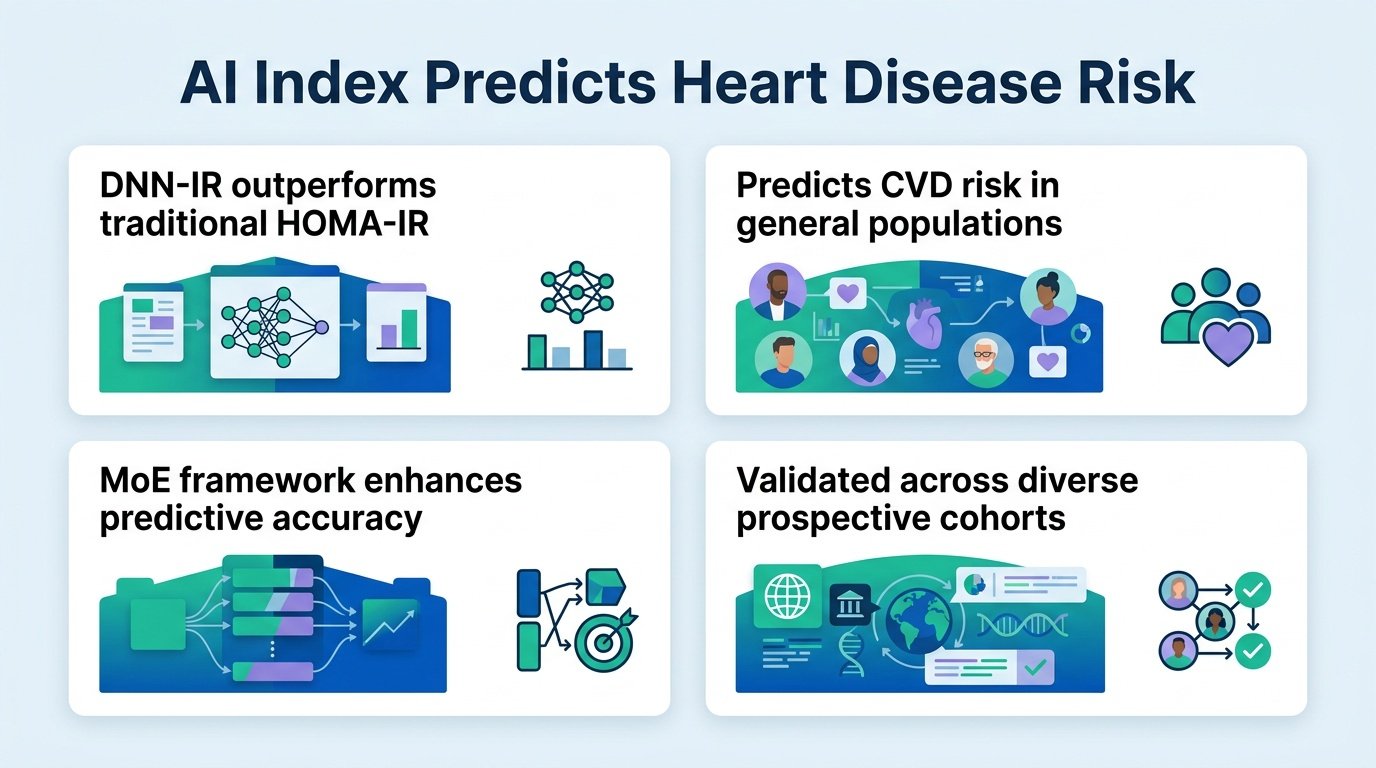
A new deep learning index predicts cardiovascular death by tracking insulin resistance in the general public, moving metabolic screening beyond diabetic patients.
How do we catch a silent killer before the first symptom appears? Traditional insulin resistance tools are built for diabetic patients, leaving a massive blind spot in the general population. This gap means millions of people with early metabolic dysfunction go unnoticed until they land in the emergency room with a heart attack.
A new preprint study introduces the DNN-IR index, a deep learning tool built on a Mixture-of-Experts framework. This model shifts the focus from managing established disease to predicting future cardiovascular catastrophes. It suggests that metabolic markers can serve as early warning systems for the heart, aligning with broader efforts to use machine learning in metabolic syndrome for early risk stratification.
The metabolic blind spot
The researchers trained their model on the Chinese REACTION study and validated it across two massive, diverse datasets. They analyzed 13,889 participants from the US NHANES cohort (1999-2018) and 7,047 participants from the Chinese CHARLS cohort (2011-2018). During a median 7-year follow-up in the CHARLS group, 1,135 participants (16.1%) developed cardiovascular disease.
This cross-border validation proves the AI is not just memorizing local patterns.
By the numbers
The AI proved highly accurate across different populations and clinical endpoints:
- An AUROC of 0.89 in training and 0.84 in internal validation on the REACTION cohort.
- A 23% increase in cardiovascular disease risk for every 1-SD increment in the index.
- An AUROC of 0.77 for cardiovascular mortality and 0.72 for all-cause mortality in the NHANES cohort.
- Strong predictive scores for death from kidney disease (0.96), diabetes (0.91), and Alzheimer’s disease (0.88).
This predictive power extended far beyond heart disease. The high scores for non-cardiovascular deaths suggest insulin resistance is a common denominator for systemic decline, reinforcing how machine learning approaches to cardiovascular disease must account for broader metabolic health.
The clinical reality
This tool matters because it bypasses the need for expensive, specialized fasting insulin tests. Instead of relying on complex lab workups, clinicians can potentially flag high-risk patients using more accessible data points. If this index can be integrated into electronic health records, it could automatically flag patients during routine annual physicals. This would turn passive data into an active defense system.
However, we must be realistic about the limits. The study relies on historical cohorts, and a preprint model is not yet an active clinical tool. We need prospective clinical trials to prove that intervening based on these AI scores actually saves lives.
Read the full study in medRxiv.