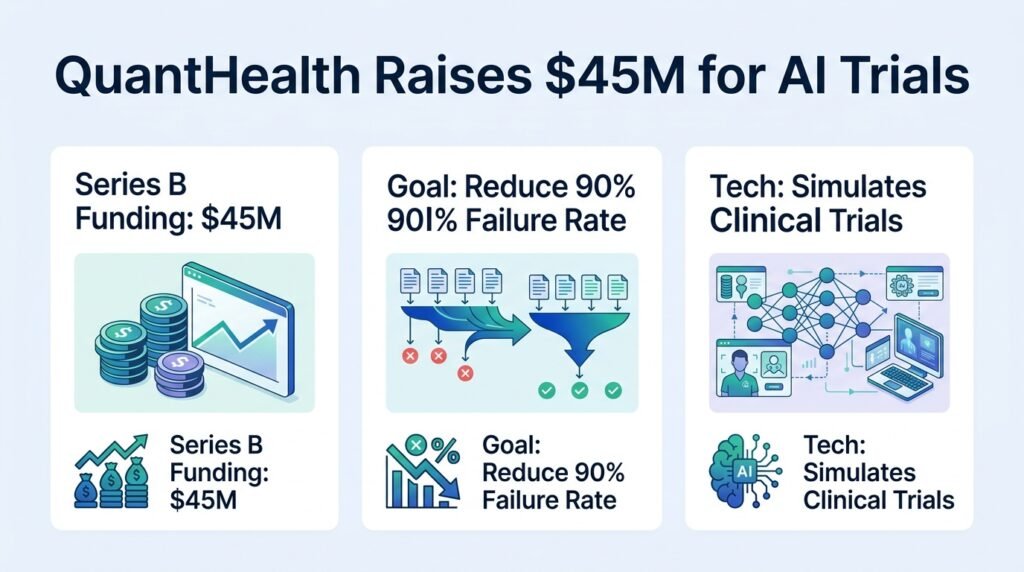
Pharma is moving from AI-driven drug discovery to AI-driven trial simulation to fix a costly ninety percent failure rate.
Why spend billions of dollars testing molecules on real humans when a digital replica can fail first?
For decades, the pharmaceutical industry has tolerated a brutal reality. Nine out of ten drugs that enter clinical trials ultimately fail. This bottleneck drains billions of dollars and stalls life-saving treatments.
Now, the investment thesis is shifting. While early-stage AI drug discovery captured the initial hype, the real financial drain happens during clinical development.
The Simulation Shift
QuantHealth just secured a forty-five million dollar Series B round to scale its simulation platform. The startup uses biomedical knowledge graphs to predict patient outcomes before a trial even begins.
This is not just a theoretical exercise. The company already partners with twelve of the top twenty global pharmaceutical companies. Their sales grew eightfold in 2025, bringing their total funding to seventy-five million dollars.
By simulating trials, sponsors can optimize protocols, select the right patient cohorts, and identify safety red flags early.
The Reality Check
But digital twins are not perfect. A simulation is only as good as the historical data feeding it.
If the underlying biomedical graphs lack diversity or contain bias, the simulated trial will replicate those same flaws. Regulators will still require rigorous human testing before approval.
However, reducing the trial-and-error phase could drastically lower development costs. The shift toward simulation-first development is no longer a luxury. It is becoming a survival strategy for modern drug portfolios.