A new clinical model outperforms specialists in diagnosing skin cancer, but its hidden failure modes reveal why deploying diagnostic AI remains a high-stakes gamble.
Can we trust an algorithm to replace a physical biopsy? For patients with suspected basal cell carcinoma, the physical slice of a scalpel remains the gold standard. A new multi-endpoint AI framework aims to change that, but its most important lesson is not how well it performs. The real story is how easily local customization can blind diagnostic software to rare dangers.
This study challenges the common assumption that feeding more multimodal data into an AI always yields better clinical decisions. It also exposes a critical trade-off. Tuning an AI to work better in a specific local clinic can severely compromise its safety net, making it blind to patients who do not fit the mold.
Key performance metrics
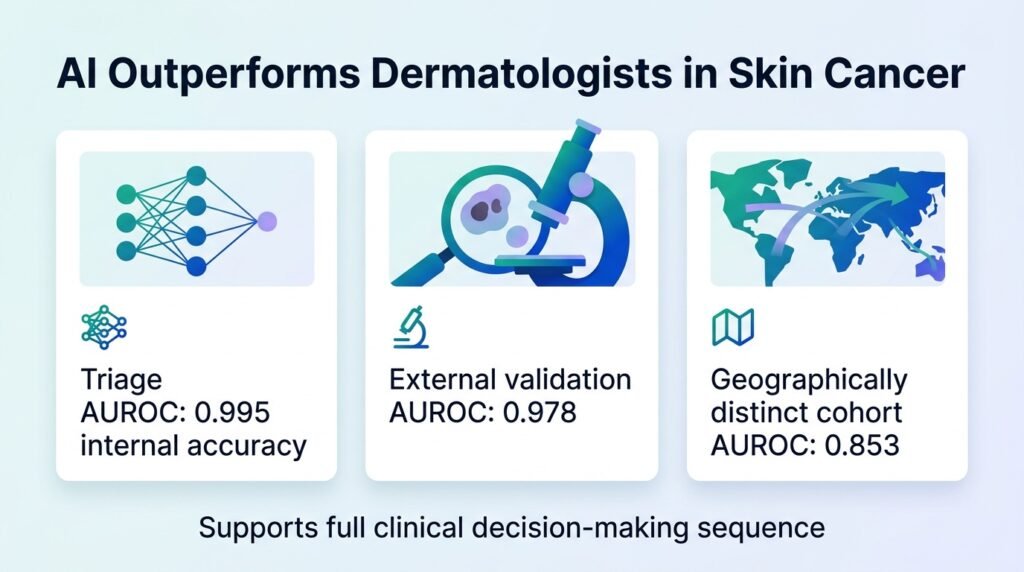
- The model achieved a triage macro-AUROC of 0.995 internally, 0.978 externally, and 0.853 in a geographically distinct cohort.
- Risk stratification reached 0.943 and 0.899 across the tested cohorts.
- For tumor thickness, using dermoscopy alone yielded a precision of 0.949, compared to 0.881 when combining all data modalities.
- The system outperformed the mean of 19 dermatologists across all primary metrics with a significance of P ≤ 0.014.
Less data, better decisions
The researchers trained their model on 1,459 internal patients and tested it on 995 external patients. The most striking finding was that more data actually degraded the AI’s performance. Clinicians assumed that combining multiple imaging modalities would yield the sharpest results for measuring tumor thickness. Instead, simpler inputs proved superior.
This counter-intuitive result suggests that clinical AI developers may be over-engineering their inputs. Adding more data streams can introduce clinical noise instead of useful signals. This finding supports ongoing efforts to design light-weight deep learning models that prioritize efficiency over complexity for remote triage.
The local adaptation trap
The system faltered when researchers tried to adapt it to local clinical settings. Local adaptation successfully boosted in-scope accuracy from 0.790 to 0.954. However, this optimization had a dangerous side effect. It began misrouting unfamiliar, out-of-scope cases into “no-further-assessment” categories.
This shift caused the AI’s sensitivity to plummet from 0.953 to 0.697 for those out-of-scope cases. In a real clinic, that drop means missed cancers. Even when researchers added a Mahalanobis gate to filter out anomalous inputs—which kept sensitivity at 0.775 at 0.791 coverage—it only partially fixed the routing errors. This issue is crucial as the field transitions to diagnosing multiple skin diseases in live clinical environments.
What we must rethink
This performance gap proves that high accuracy in a closed lab environment does not guarantee clinical safety. When we customize AI for local clinics, we risk creating blind spots that quietly dismiss complex cases. For biopsy-sparing AI to succeed, developers must validate how these systems handle uncertainty, not just how well they classify typical cases.
Until scope control is solved, the scalpel remains irreplaceable.
Read the full preprint in medRxiv.