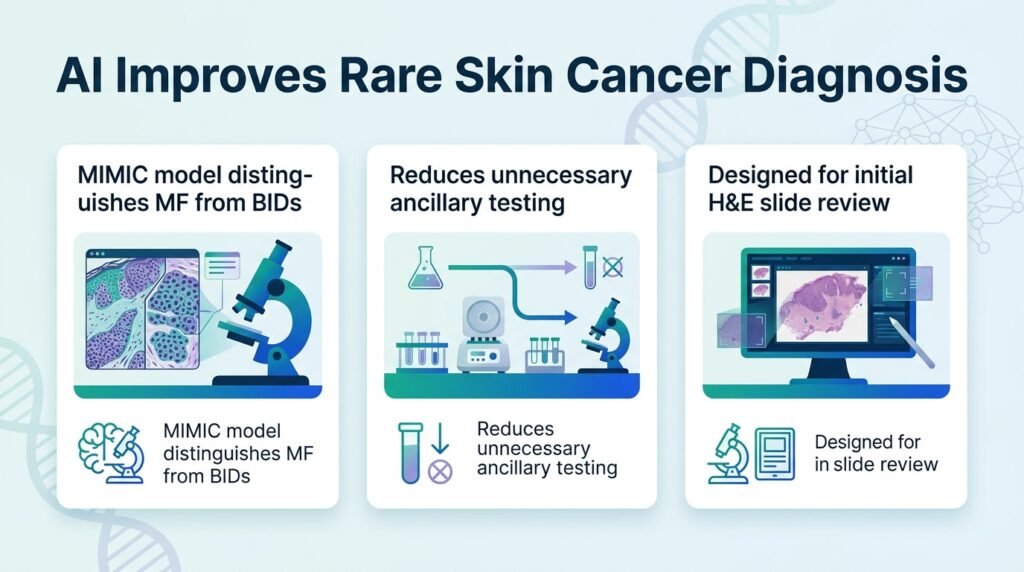
A new deep learning tool could stop pathologists from ordering endless, defensive tests to rule out a mimic of common skin rashes.
How do you catch a rare, deadly skin cancer when it looks exactly like eczema? For years, pathologists have struggled to distinguish early-stage mycosis fungoides from harmless skin rashes. The fear of missing this cancer leads to a mountain of defensive, expensive lab tests.
This is not just about showing that AI can read slides. It challenges the traditional workflow of diagnostic pathology. By acting as a strict triage filter rather than a final diagnostic judge, the algorithm targets the real bottleneck in clinical labs: the sheer volume of “just in case” testing. For years, the industry has focused on AI as a replacement for human doctors. This study suggests a different path, using algorithms to filter out the noise so humans can focus on the signal.
Researchers built MIMIC, a deep learning model trained on 3,339 whole slide images from Dutch medical centers. They tested its adaptability on 371 images from four other European clinics. To see how it stacked up against human eyes, they ran a reader study with 171 images, pitting the AI against 11 pathologists.
Beating the human experts
The algorithm did not just match the specialists; it beat them. In the reader study, the AI scored an area under the receiver operating characteristic (AUROC) of 0.87. The human pathologists averaged 0.79, and even the best individual human reader only reached 0.83.
Next, researchers tested an updated version on a real-world group of 453 patient cases from Utrecht. The model maintained its strong performance with an AUROC of 0.87.
Safe triage in practice
But the real value is in the triage strategy. By setting a highly sensitive safety threshold of 0.04, the model caught 97.8% of the cancer cases, identifying 44 out of 45 actual malignancies.
This high sensitivity came with a specificity of 50.2%. While that sounds low, it is actually a massive win for lab efficiency. It means the AI can confidently clear half of the benign cases without any human intervention, allowing pathologists to focus their energy on the difficult, borderline cases.
- The model achieved a pooled AUROC of 0.84 across independent European centers.
- It successfully identified 44 out of 45 cancer cases in a real-world cohort.
- It ruled out cancer in half of the benign cases, reducing unnecessary lab workups by 39.9 per 100 patients.
The limits of European data
There is a catch. The model was trained and tested entirely on European cohorts. Skin cancers look different on different skin tones, and the researchers openly admit they have not validated this tool on darker skin phototypes. Until we see data from more diverse populations, this tool remains a promising but geographically limited solution.
Still, this study proves that AI does not need to replace the pathologist to be useful. By safely ruling out cancer in half of the benign cases, it clears the diagnostic runway for the patients who actually need urgent care.
Read the full study in medRxiv.