A massive screening study reveals that chest X-ray AI can flag lung tumors before human radiologists, but its real value lies in how we manage the noise it creates.
If an AI flags a shadow that two board-certified radiologists missed, is it a lifesaver or a false alarm? In mass health screenings, this distinction dictates whether a patient gets timely care or falls into a spiral of unnecessary testing.
A new study analyzing nearly 300,000 X-rays challenges the assumption that AI must be a perfect diagnostic tool to be useful. Instead, it suggests that AI’s best role in preventative health is acting as an ultra-sensitive safety net, even if it forces clinicians to rethink how they handle borderline cases.
Researchers evaluated a commercial AI system on 298,991 chest radiographs from 114,866 individuals between 2019 and 2023. The scans were originally interpreted under routine double reading by board-certified radiologists. The team tested the AI using a manufacturer-recommended score threshold of 15 across two different screening strategies.
How the AI performed
The AI was evaluated against the radiologists’ original decisions. When looking for any of ten different chest findings, the system showed moderate agreement. However, when the analysis narrowed specifically to nodules and masses, the AI’s accuracy spiked significantly.
- In the all-score analysis, the AI achieved 72.0% sensitivity and 79.6% specificity.
- In the nodule-focused analysis, sensitivity rose to 87.1% and specificity reached 91.8%.
- The negative predictive value was 99.0% for all findings and 100.0% for nodules.
The early detection signal
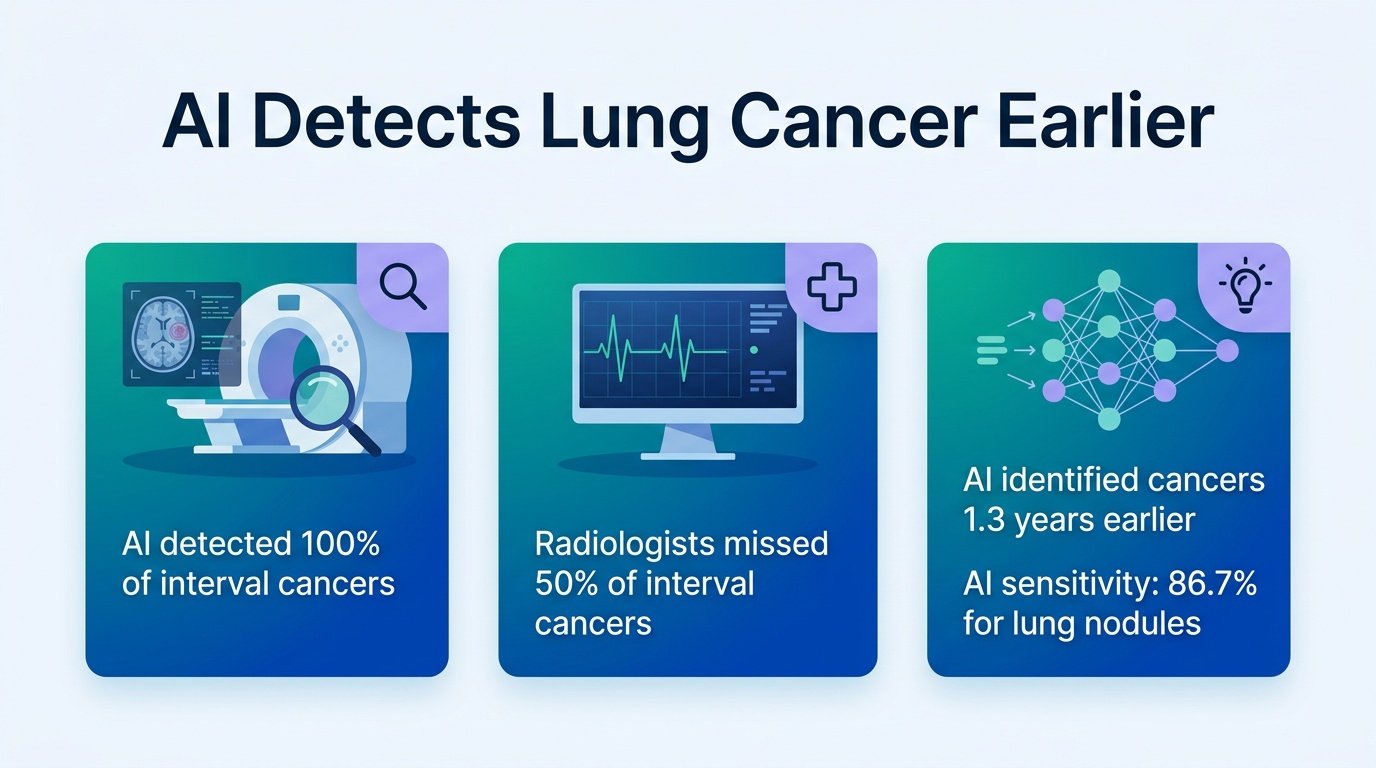
The most compelling finding emerged from 48 histopathologically confirmed lung cancer cases. Retrospective timeline analyses showed that the AI flagged abnormalities earlier than the human radiologists in a subset of these patients. This aligns with ongoing discussions about integrating algorithms into clinical workflows to catch early-stage malignancies, as explored in the EBioMedicine study on workflow standardization.
Yet, this early warning system comes with a trade-off. Catching a tumor early is vital, but high sensitivity in mass screenings can overwhelm clinics with false positives. This tension is a known hurdle in the broader effort to use AI to assess lung cancer risk.
The limits of retrospect
We must treat these early-detection findings with caution. Because this was a retrospective study, it cannot prove that using the AI prospectively would have changed patient outcomes. Furthermore, the study used radiologist judgment as the reference standard rather than universal CT scans for every participant, meaning some missed cancers might have been overlooked entirely.
Ultimately, the study proves that AI is highly stable and concordant with human readers in large-scale check-ups. The real challenge now is not improving the algorithm, but building clinical protocols that can handle the early warnings without triggering a wave of unnecessary biopsies.
Read the full study in medRxiv.